Question
Two bodies make an elastic head$-$on collision on a smooth horizontal table kept in a car. Do you expect a change in the result if the car is accelerated on a horizontal road because of the noninertial character of the frame? Does the equation "Velocity of separation $=$ Velocity of approach" remain valid in an accelerating car? Does the equation "Final momentum $=$ Initial momentum" remain valid in the accelerating car?
Answer

In case car is accelerated it would affect velocity of both bodies,
  1. In this case the change in velocity would affect velocity of both bodies. $($body moving in direction of car would slow down and other one moving in opposite direction would speed up in case car is accelerated$)$
  2. Velocity of separation would be equal to velocity of approach. As only change would be in velocity but everything would remain same.
  3. Yes final momentum would be still equal to initial momentum as with increase in velocity of one body the velocity of other body does decrease.

Need a full question paper?

Generate a complete, print-ready paper with questions like this in minutes — across 16+ boards, with answer keys.

Start Generating Free

Similar questions

  1. What is meant by Simple Harmonic Motion $\text{(S.H.M)}$?
  2. At what points is the energy entirely kinetic and potential in $\text{S.H.M}$?
  3. What is the total distance travelled by a body executing $\text{S.H.M}$ in a time equal to its time period, if its amplitude is $A$?
Calculate the velocity of sound in a gas, in which two wavelengths 2.04m and 2.08m produce 20 beats in 6 seconds.
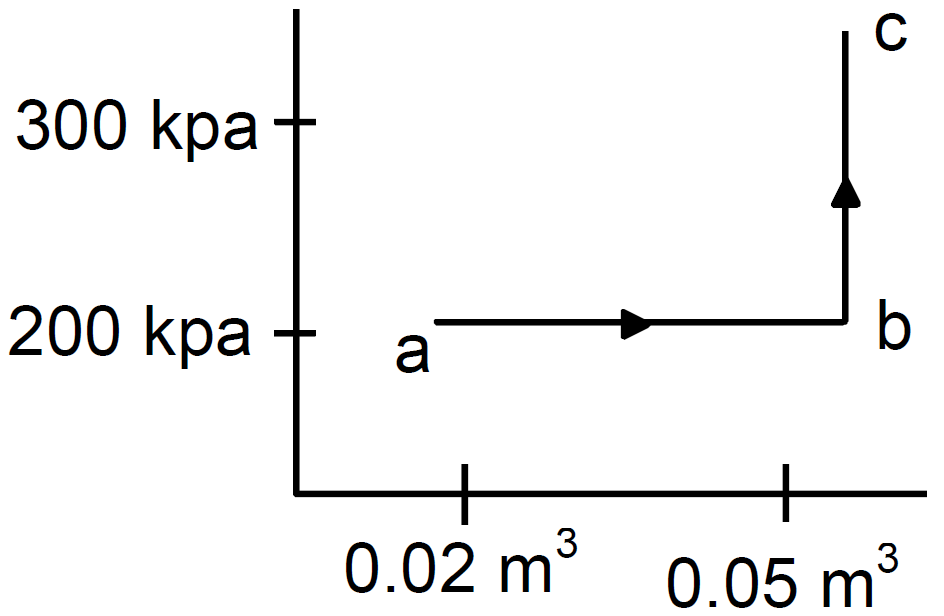
A substance is taken through the process abc as shown in figure. If the internal energy of the substance increases by 5000J and a heat of 2625cal is given to the system, calculate the value of J.
A ball of mass m, moving with a speed $2v_0,$ collides inelastically $(e > 0)$ with an identical ball at rest. Show that:
For head-on collision, both the balls move forward.
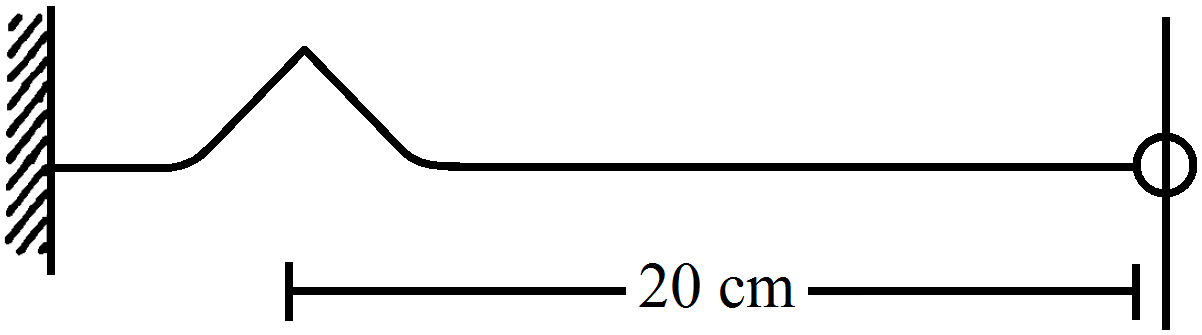
A string of linear mass density $0.5g/cm$ and a total length $30\ cm$ is tied to a fixed wall at one end and to a frictionless ring at the other end figure, The ring can move on a vertical rod. A wave pulse is produced on the string which moves towards the ring at a speed of $20\ cm/s.$ The pulse is symmetric about its maximum which is located at a distance of $20\ cm$ from the end joined to the ring.
  1. Assuming that the wave is reflected from the ends without loss of energy, find the time taken by the string to regain its shape.
  2. The shape of the string changes periodically with time. Find this time period.
  3. What is the tension in the string?
A trolley of mass $300kg$ carrying a sandbag of $25kg$ is moving uniformly with a speed of $27km/h$ on a frictionless track. After a while, sand starts leaking out of a hole on the floor of the trolley at the rate of $0.05 kgs^{-1}$. What is the speed of the trolley after the entire sand bag is empty?
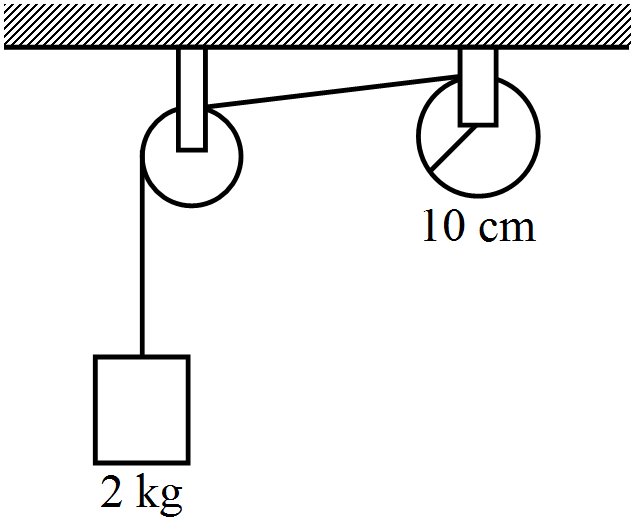
A string is wrapped on a wheel of moment of inertia $0.20kg-m^2$ and radius 10cm and goes through a light pulley to support a block of mass $2.0kg$ as shown in figure. Find the acceleration of the block.
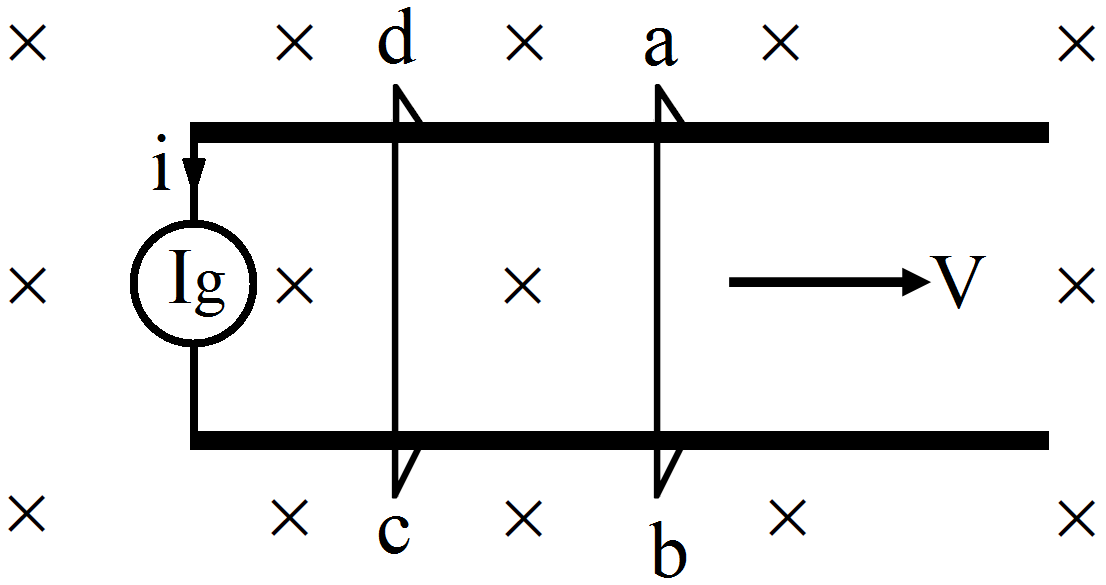
The current generator $I_g$ shown in figure, sends a constant current i through the circuit. The wire cd is fixed and ab is made to slide on the smooth, thick rails with a constant velocity v towards right. Each of these wires has resistance r. Find the current through the wire cd.
Suppose the rod in the previous problem has a mass of $1\ kg$ distributed uniformly over its length:
  1. Find the initial angular acceleration of the rod.
  2. Find the tension in the supports to the blocks of mass $2\ kg$ and $5\ kg$.