MCQ
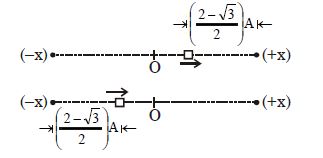
Two bodies performing $SHM$ have same amplitude and frequency. Their phases at a certain instant are as shown in the figure. The phase difference between them is
- ✓$\frac{{2\pi }}{3}$
- B$\pi $
- C$\frac{\pi }{3}$
- DNone of these
$=\mathrm{A}-\left(\frac{2-\sqrt{3}}{2}\right) \mathrm{A}=\frac{\sqrt{3}}{2} \mathrm{A}$
So phase of the particle which is going
towards $+x$ is $\phi_{1}=\frac{\pi}{3}$
and for other particle $\phi_{2}=2 \pi-\frac{\pi}{3}=\frac{5 \pi}{3}$
phase difference $=\frac{5 \pi}{3}-\frac{\pi}{3}$
$=\frac{4 \pi}{3}$ or $\left(2 \pi-\frac{4 \pi}{3}\right)$
$=\frac{4 \pi}{3}$ or $\frac{2 \pi}{3}$
Generate a complete, print-ready paper with questions like this in minutes — across 16+ boards, with answer keys.
Let the respective electric fluxes through the surfaces be ${\phi _1},{\phi _2},{\phi _3}$ and ${\phi _4}$ . Then