Question
Two bodies undergo one$-$dimensional, perfectly inelastic, head$-$on collision. Derive an expression for the loss in the kinetic energy.

Answer

$i.$ Let two bodies $A$ and $B$ of masses $m_1$ and $m_2$ move with initial
velocity $\overrightarrow{ u }_1$ and $\overrightarrow{ u }_2$, respectively such that particle $A$ collides head on with particle $B$ i.e., $u _1> u _2$.
$ii.$ If the collision is perfectly inelastic, the particles stick together and move with a common velocity $\overrightarrow{ v }$ after the collision along the same straight line.
loss in kinetic energy = total initial kinetic energy $–$ total final kinetic energy.
$iii.$ By the law of conservation of momentum,
$m_1u_1 + m_2u_2 = (m_1 + m_2)v$
$\therefore V=\frac{ m _1 u _1+ m _2 u _2}{m_1+ m _2}$
$iv.$ Loss of Kinetic energy,
$\Delta K.E. =\left(\frac{1}{2} m_1 u_1^2+\frac{1}{2} m_2 u_2^2\right)-\frac{1}{2}\left(m_1+m_2\right) v^2$
$=\left(\frac{1}{2} m_1 u_1^2+\frac{1}{2} m_2 u_2^2\right)-\frac{1}{2}\left(m_1+m_2\right)\left[\frac{m_1 u_1+m_2 u_2}{m_1+m_2}\right]^2$.
$=\frac{ m _1^2 u _1^2+ m _1 m_2 u _2^2+ m _1 m_2 u _1^2}{2\left(m_1+ m _2\right)}+\frac{ m _2^2 u _2^2- m _1^2 u _1^2- m _2^2 u _2^2-2 m_1 m_2 u _1 u _2}{2\left(m_1+ m _2\right)}$
$=\frac{m_1 m_2}{2\left(m_1+m_2\right)}\left(u_1-u_2\right)^2$
$iv.$ Both the masses and the term $(u_1 – u_2)^2$ are positive. Hence, there is always a loss in a perfectly inelastic collision. For a perfectly inelastic collision, as $e = 0,$ the loss is maximum.

Need a full question paper?

Generate a complete, print-ready paper with questions like this in minutes — across 16+ boards, with answer keys.
Start Generating Free

Similar questions

Explain how solids are classified on the basis of band theory of solids.
The magnitude of current density in a copper wire is $500 A/cm²$. If the number of free electrons per cm³ of copper is $8.47 \times 10^{22}$​​​​​​​, calculate the drift velocity of the electrons through the copper wire (charge on an $e = 1.6 \times 10^{-19} C$)
Explain formation of energy bands in solid sodium with neat labelled energy band diagrams.
A batsman deflects a ball by an angle of $45^\circ$ without changing its initial speed which is equal to $54 \ km/h.$ What is the impulse imparted to the ball? $($Mass of the ball is $0.15 \ kg).$
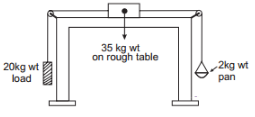
Figure below shows a block of mass $35\ kg$ resting on a table. The table is so rough that it offers a self adjusting resistive force $10 \%$ of the weight of the block for its sliding motion along the table. A $20\ kg$ wt load is attached to the block and is passed over a pulley to hang freely on the left side. On the right side there is a $2\ kg$ wt pan attached to the block and hung freely. Weights of $1\ kg$ wt each, can be added to the pan. Minimum how many and maximum how many such weights can be added into the pan so that the block does not slide along the table? [Ans: Min $15$, maximum $21$].
Image
A metal sphere cools at the rate of $0.05^{\circ} C / s$ when its temperature is $70^{\circ} C$ and at the rate of $0.025^{\circ} C / s$ when its temperature is $50^{\circ} C$. Determine the temperature of the surroundings and find the rate of cooling when the temperature of the metal sphere is $40^{\circ} C$.
Explain concept of valence band and conduction band in solid crystal.
Derive equations of motion graphically for a particle having uniform acceleration, moving along a straight line.
At a given place on the Earth, a bar magnet of magnetic moment $\vec{m}$ is kept horizontal in the EastWest direction. $P$ and $Q$ are the two neutral points due to magnetic field of this magnet and $\vec{B}_{ H }$ is the horizontal component of the Earth's magnetic field.
$i$. Calculate the angles between position vectors of $P$ and $Q$ with the direction of $\vec{m}$.
$ii$. Points $P$ and $Q$ are $1 m$ from the centre of the bar magnet and $B_H=3.5 \times 10^{-5} T$. Calculate magnetic dipole moment of the bar magnet.
Neutral point is that point where the resultant magnetic field is zero.
An aluminium rod and iron rod show $1.5\ m$ difference in their lengths when heated at all temperature. What are their lengths at $0^{\circ} C$ if coefficient of linear expansion for aluminium is $24.5 \times 10^{-6} /{ }^{\circ} C$ and for iron is $11.9 \times 10^{-6} /{ }^{\circ} C$