Motion in a Plane — Physics STD 11 Science — Question
Maharashtra BoardEnglish MediumSTD 11 SciencePhysicsMotion in a Plane4 Marks
Question
Derive equations of motion graphically for a particle having uniform acceleration, moving along a straight line.
✓
Answer
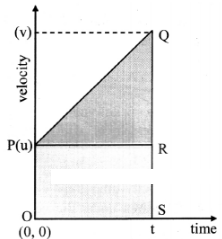
Consider an object starting from position x = 0 at time t = 0. Let the velocity at time (t = 0) and t be u and v respectively.
The slope of line PQ gives the acceleration. Thus
$ \therefore a =\frac{ v - u }{ t -0}=\frac{ v - u }{ t }$
$\therefore v = u + at . \ldots \ldots \ldots \ldots . $ This is the first equation of motion.
The area under the curve in velocity-time graph gives the displacement of the object.
∴ s = area of the quadrilateral OPQS = area of rectangle OPRS + area of triangle PQR.
$=u t+\frac{1}{2}(v-u) t$
But, from equation (1)
at $= v - u$
$\therefore s=u t+\frac{1}{2} a t^2$
This is the second equation of motion,
The velocity is increasing linearly with time as acceleration is constant. The displacement is given as,
$ s = v _{ av } t =\left(\frac{ v + u }{2}\right) t$
$=\frac{( v + u )( v - u )}{2( v - u )} t$
$=\frac{(v+u)(v-u)}{2 a}$
$\therefore s =\left( v ^2-u^2\right) /(2 a)$
$\therefore v ^2- u ^2=2 as$
This is the third equation of motion.
Need a full question paper?
Generate a complete, print-ready paper with questions like this in minutes — across 16+ boards, with answer keys.