MCQ
Two bottles $A$ and $B$ have radii $R_{A}$ and $R_{B}$ and heights $h_{A}$ and $h_{B}$ respectively, with $R_{B}=2 R_{A}$ and $h_{B}=2 h_{A}$. These are filled with hot water at $60^{\circ} C$. Consider that heat loss for the bottles takes place only from side surfaces. If the time, the water takes to cool down to $50^{\circ} C$ is $t_{A}$ and $t_{B}$ for bottles $A$ and $B$, respectively. Then, $t_{A}$ and $t_{B}$ are best related as
  • A
    $t_{A}=t_{B}$
  • $t_{B}=2 t_{A}$
  • C
    $t_{B}=4 t_{A}$
  • D
    $t_{B}=t_{A} / 2$

Answer

Correct option: B.
$t_{B}=2 t_{A}$
b
$(b)$ Rate of heat loss for two bodies of same specific heat's and same density for which temperature difference (of bodies and surroundings) is same is given by

$\frac{\Delta T-h A}{\Delta t}$

where, $\Delta T=$ temperature change $\left(T_{f}-T_{i}\right)$, $\Delta t=$ time interval, $k=$ a constant

depending on shape of bodies, $A=$ surface area and $V=$ volume.

As in given case, bottles are identical and they cool down by same temperatures,

$\Delta t \propto \frac{V}{A}$

$\text { So, } \Delta t \propto \frac{A \cdot h}{A} \text { or } \Delta t \propto h$

$\therefore \quad \frac{t_{A}}{t_{B}}=\frac{h_{A}}{h_{B}} \Rightarrow \frac{t_{A}}{t_{B}}=\frac{h_{A}}{2 h_{A}} \quad\left[\therefore h_{B}=2 h_{A}\right]$

$\Rightarrow \quad t_{B}=2 t_{A}$

Need a full question paper?

Generate a complete, print-ready paper with questions like this in minutes — across 16+ boards, with answer keys.

Start Generating Free

Similar questions

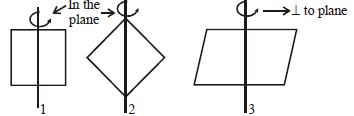
Three identical square plates rotate about the axes shown in the figure in such a way that their kinetic energies are equal. Each of the rotation axes passes through the centre of the square. Then the ratio of angular speeds $\omega _1 : \omega _2 : \omega _3$ is
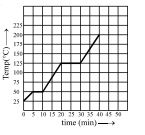
The graph shown in the figure represent change in the temperature of $5 \,\,kg$ of a substance as it abosrbs heat at a constant rate of $42 \,\,kJ min^{-1}$. The latent heat of vapourazation of the substance is ......... $kJ \,kg^{-1}$
$P-V$ diagram of a diatomic gas is a straight line passing through origin. The molar heat capacity of the gas in the process will be 
A wire of area of cross-section ${10^{ - 6}}{m^2}$ is increased in length by $0.1\%$. The tension produced is $1000 N$. The Young's modulus of wire is
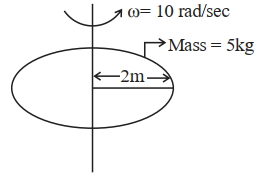
Consider a Disc of mass $5 \mathrm{~kg}$, radius $2 \mathrm{~m}$, rotating with angular velocity of $10 \mathrm{rad} / \mathrm{s}$ about an axis perpendicular to the plane of rotation. An identical disc is kept gently over the rotating disc along the same axis. The energy dissipated so that both the discs continue to rotate together without slipping is ___________$J$.
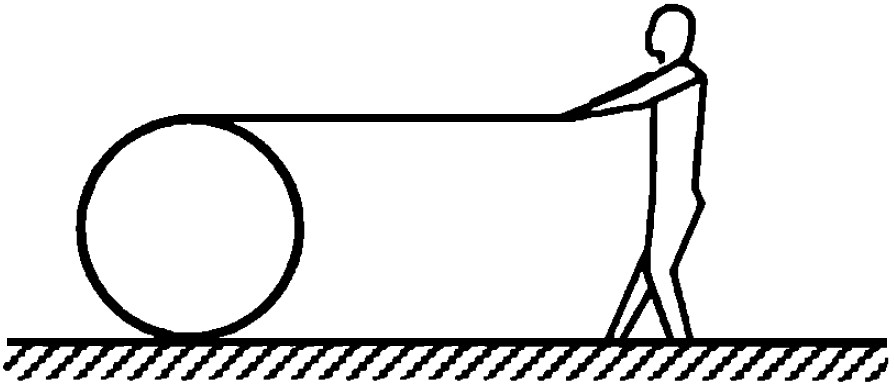
A string of negligible thickness is wrapped several times around a cylinder kept on a rough horizontal surface. A man standing at a distance $1$ from the cylinder holds one end of the string and pulls the cylinder towards him. There is no slipping anywhere. The length of the string passed through the hand of the man while the cylinder reaches his hands is:
Energy is being emitted from the surface of a black body at $127\,^oC$ temperature at the rate of $1.0 \times {10^6}\,J/s - {m^2}$. Temperature of the black body at which the rate of energy emission is $16.0 \times {10^6}\,J/s - {m^2}$ will be   ......... $^oC$
Zero error of an instrument introduces
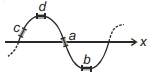
Figure shows a snapshot for a travelling sine wave along a string. Four elemental portions $a, b, c$ and $d$ are indicated on the string. The elemental portion which has maximum potential energy is/are
A silver ingot weighing $2.1 kg$  is held by a string so as to be completely immersed in a liquid of relative density $0.8$. The relative density of silver is $10.5$ . The tension in the string in $kg-wt$ is