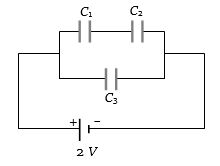
Two capacitors ${C_1} = 2\,\mu \,F$ and ${C_2}\, = \,6\,\mu \,F$ in series, are connected in parallel to a third capacitor ${C_3} = \,4\,\mu \,F$. This arrangement is then connected to a battery of $e.m.f.$ $=$ $2V$, as shown in the figure. How much energy is lost by the battery in charging the capacitors
Medium


Download our appand get started for free
Experience the future of education. Simply download our apps or reach out to us for more information. Let's shape the future of learning together!No signup needed.*
Similar Questions
- 1Two spheres $A$ and $B$ of radius $a$ and $b$ respectively are at same electric potential. The ratio of the surface charge densities of $A$ and $B$ isView Solution
- 2View SolutionA spherical portion has been removed from a solid sphere having a charge distributed uniformly in its volume in the figure. The electric field inside the emptied space is

- 3A capacitor $4\,\mu F$ charged to $50\, V$ is connected to another capacitor of $2\,\mu F$ charged to $100 \,V$ with plates of like charges connected together. The total energy before and after connection in multiples of $({10^{ - 2}}\,J)$ isView Solution
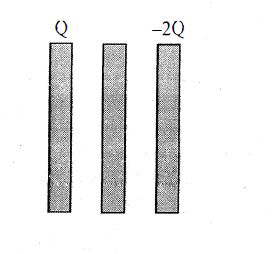
- 4The identical metal plates with large surface areas are kept parallel to each other as shown in figure. The left most plate is given a charge $Q$ , the rightmost a charge $-2Q$ and the middle one remains neutral. Find the charge appearing on the outer surface of the rightmost plateView Solution
- 5A particle of mass $m$ and carrying charge $-q_1$ is moving around a charge $+q_2$ along a circular path of radius r. Find period of revolution of the charge $-q_1$View Solution
- 6Kinetic energy of an electron accelerated in a potential difference of $100\, V$ isView Solution
- 7Two capacitors of capacities $2 {C}$ and ${C}$ are joined in parallel and charged up to potential ${V}$. The battery is removed and the capacitor of capacity $C$ is filled completely with a medium of dielectric constant ${K}$. The potential difference across the capacitors will now beView Solution
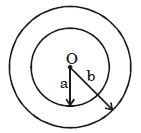
- 8If electric potential of the inner sphere is $10\, volt$ and that of the outer shell is $50\, volt$ then potential at common centre is :-......$V$View Solution
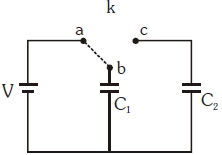
- 9Two Identical capacttors $\mathrm{C}_{1}$ and $\mathrm{C}_{2}$ of equal capacitance are connected as shown in the circult. Terminals $a$ and $b$ of the key $k$ are connected to charge capacitor $\mathrm{C}_{1}$ using battery of $emf \;V\; volt$. Now disconnecting $a$ and $b$ the terminals $b$ and $c$ are connected. Due to this, what will be the percentage loss of energy?.....$\%$View Solution
- 10Two opposite and equal charges $4 \times {10^{ - 8}}\,coulomb$ when placed $2 \times {10^{ - 2}}\,cm$ away, form a dipole. If this dipole is placed in an external electric field $4 \times {10^8}\,newton/coulomb$, the value of maximum torque and the work done in rotating it through $180^\circ $ will beView Solution