Question
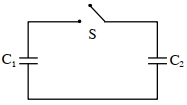
Two capacitors having capacitance $C _{1}$ and $C _{2}$ respectively are connected as shown in figure. Initially, capacitor $C _{1}$ is charged to a potential difference $V$ volt by a battery. The battery is then removed and the charged capacitor $C_{1}$ is now connected to uncharged capacitor $C _{2}$ by closing the switch $S$. The amount of charge on the capacitor $C _{2}$, after equilibrium is
Answer

Charge on capacitor $C _{2}$

$=\frac{ C _{2} \times Q _{\text {total }}}{ C _{\text {total }}}=\frac{ C _{2}\left[ C _{1} V \right]}{ C _{1}+ C _{2}}=\frac{ C _{1} C _{2} V }{ C _{1}+ C _{2}}$

Need a full question paper?

Generate a complete, print-ready paper with questions like this in minutes — across 16+ boards, with answer keys.

Start Generating Free

Similar questions

A nucleus of mass $M + \Delta m$ is at rest and decays into two  daughter nuclei of equal mass $\frac{M}{2}$ each. Speed of light is $c.$

The speed of daughter nuclei is

Which of the following is a dimension of volt 
Cooling rate of a sphere of $600\,K$ at external environment $(200\,K)$ is $R$ . When the temperature of sphere is reduced to $400\,K$ then cooling rate of the sphere becomes
A candle placed $25 cm$ from a lens, forms an image on a screen placed $75 cm$ on the other end of the lens. The focal length and type of the lens should be
For a constant collector-emitter voltage of $8\,V$, the collector current of a transistor reached to the value of $6\,mA$ from $4\,mA$, whereas base current changed from $20\,\mu A$ to $25\,\mu\,A$ value. If transistor is in active state, small signal current gain (current amplification factor) will be.
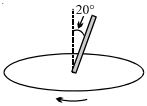
$A$ uniform rod is fixed to a rotating turntable so that its lower end is on the axis of the turntable and it makes an angle of $20^o$ to the vertical. (The rod is thus rotating with uniform angular velocity about a vertical axis passing through one end.) If the turntable is rotating clockwise as seen from above. Is there a torque acting on it, and if so in what direction?
An optical arrangement consists of two concave mirrors $M_1$ and $M_2$, and a convex lens $L$ with a common principal axis, as shown in the figure. The focal length of $L$ is $10 \mathrm{~cm}$. The radii of curvature of $M_1$ and $M_2$ are $20 \mathrm{~cm}$ and $24 \mathrm{~cm}$, respectively. The distance between $\mathrm{L}$ and $M_2$ is $20 \mathrm{~cm}$. A point object $S$ is placed at the mid-point between $L$ and $M_2$ on the axis. When the distance between $\mathrm{L}$ and $M_1$ is $n / 7 \mathrm{~cm}$, one of the images coincides with $S$. The value of $n$ is. . . . 
A voltmeter having resistance of $50 × 10^3$ $Omega$ is used to measure the voltage in a circuit. To increase the range of measurement $3$ times the additional series resistance required is
Two charged particles of mass $m$ and charge $q$ each are projected from origin simultaneously with same speed $V$ in transverse magnetic field. If ${\vec r_1}$ and ${\vec r_2}$ are the position vectors of particles (with respect to origin) at $t = \frac{{\pi m}}{{qB}}$ then the value of  ${\vec r_1}.{\vec r_2}$ at that time is
The given diagram shows two semi infinite line of charges having equal (in magnitude) linear charge density but with opposite sign. The electric field at any point on $x$ axis for $(x > 0)$ is along the unit vector