Cooling rate of a sphere of $600\,K$ at external environment $(200\,K)$ is $R$ . When the temperature of sphere is reduced to $400\,K$ then cooling rate of the sphere becomes
Medium
Download our app for free and get started
$\mathrm{R}_{1} \propto(600)^{4}-(200)^{4}$
$\mathrm{R}_{2} \propto(400)^{4}-(200)^{4}$
$\frac{\mathrm{R}_{2}}{\mathrm{R}_{1}}=\frac{(16+4)(16-4)}{(36+4)(36-4)}=\frac{20 \times 12}{40 \times 32}$
$\mathrm{R}_{2}=\frac{3}{16} \mathrm{R}$

Download our appand get started for free
Experience the future of education. Simply download our apps or reach out to us for more information. Let's shape the future of learning together!No signup needed.*
Similar Questions
- 1A black body at a temperature of $1640\,\,K$ has the wavelength corresponding to maximum emission equal to $1.75 \,\,\mu m.$ Assuming the moon to be a perfectly black body, the temperature of the moon, if the wavelength corresponding to maximum emission is $14.35\,\,\mu m$ is.......$K$View Solution
- 2Two spherical black bodies of radii ${r_1}$ and ${r_2}$ and with surface temperature ${T_1}$and ${T_2}$ respectively radiate the same power. Then the ratio of ${r_1}$ and ${r_2}$ will beView Solution
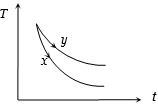
- 3The graph. Shown in the adjacent diagram, represents the variation of temperature $(T)$ of two bodies, $x$ and $y$ having same surface area, with time $(t)$ due to the emission of radiation. Find the correct relation between the emissivityView Solution
- 4It takes $10$ minutes to cool a liquid from $61^oC$ to $59^oC$. If room temperature is $30^oC$ then time taken in cooling from $51^oC$ to $49^oC$ is ....... $\min$View Solution
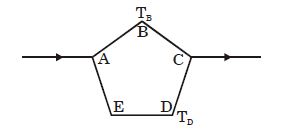
- 5$ABCDE$ is a regular pentagon of uniform wire. The rate of heat entering at $A$ and leaving at $C$ is equal. $T_B$ and $T_D$ are temperature of $B$ and $D$ . Find the temperature $T_C$View Solution
- 6The energy emitted per second by a black body at ${27^o}C$ is $10\;J$. If the temperature of the black body is increased to ${327^o}C$, the energy emitted per second will be ......... $J$View Solution
- 7Two rods, one made of copper and the other steel of the same length and cross-sectional area are joined together. The thermal conductivity of copper is $385 \,Js ^{-1} m ^{-1} K ^{-1}$ and steel is $50 \,Js ^{-1} m ^{-1} K ^{-1}$. If the copper end is held at $100^{\circ} C$ and the steel end is held at $0^{\circ} C$, the junction temperature is ........... $C$ (Assuming no other heat losses)View Solution
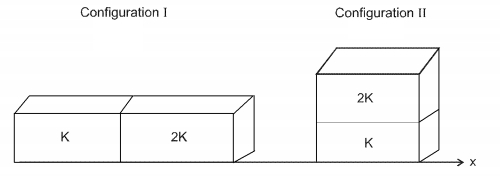
- 8Two rectangular blocks, having indentical dimensions, can be arranged either in configuration $I$ or in configuration $II$ as shown in the figure, On of the blocks has thermal conductivity $k$ and the other $2 \ k$. The temperature difference between the ends along the $x$-axis is the same in both the configurations. It takes $9\ s$ to transport a certain amount of heat from the hot end to the cold end in the configuration $I$. The time to transport the same amount of heat in the configuration $II$ is :View Solution
- 9Read the following statements:View Solution
$A.$ When small temperature difference between a liquid and its surrounding is doubled the rate of loss of heat of the liquid becomes twice.
$B.$ Two bodies $P$ and $Q$ having equal surface areas are maintained at temperature $10^{\circ}\,C$ and $20^{\circ}\,C$. The thermal radiation emitted in a given time by $P$ and $Q$ are in the ratio $1: 1.15$
$C.$ A carnot Engine working between $100\,K$ and $400\,K$ has an efficiency of $75 \%$
$D.$ When small temperature difference between a liquid and its surrounding is quadrupled, the rate of loss of heat of the liquid becomes twice.
Choose the correct answer from the options given below :
- 10A hot body, obeying Newton's law of cooling is cooling down from its peak value $80\,^oC$ to an ambient temperature of $30\,^oC$ . It takes $5\, minutes$ in cooling down from $80\,^oC$ to $40\,^oC$. ........ $\min.$ will it take to cool down from $62\,^oC$ to $32\,^oC$ ? (Given $ln\, 2\, = 0.693, ln\, 5\, = 1.609$)View Solution