Two capacitors of $3\,pF$ and $6\,pF$ are connected in series and a potential difference of $5000\,V$ is applied across the combination. They are then disconnected and reconnected in parallel. The potential between the plates is
Medium
Download our app for free and get started
(b) $\frac{1}{C} = \frac{1}{3} + \frac{1}{6}$ $==>$ $C = 2\,pF$
Total charge$ = 2 \times {10^{ - 12}} \times 5000 = {10^{ - 8}}\,C$
The new potential when the capacitors are connected in parallel is
$V = \frac{{2 \times {{10}^{ - 8}}}}{{(3 + 6) \times {{10}^{ - 12}}}} = 2222\,V$
Total charge$ = 2 \times {10^{ - 12}} \times 5000 = {10^{ - 8}}\,C$
The new potential when the capacitors are connected in parallel is
$V = \frac{{2 \times {{10}^{ - 8}}}}{{(3 + 6) \times {{10}^{ - 12}}}} = 2222\,V$

Download our appand get started for free
Experience the future of education. Simply download our apps or reach out to us for more information. Let's shape the future of learning together!No signup needed.*
Similar Questions
- 1View SolutionAn uncharged capacitor is connected to a battery. On charging the capacitor
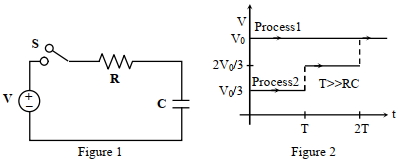
- 2Consider a simple $RC$ circuit as shown in Figure $1$.View Solution
Process $1$: In the circuit the switch $S$ is closed at $t=0$ and the capacitor is fully charged to voltage $V_0$ (i.e. charging continues for time $T \gg R C$ ). In the process some dissipation ( $E_D$ ) occurs across the resistance $R$. The amount of energy finally stored in the fully charged capacitor is $EC$.
Process $2$: In a different process the voltage is first set to $\frac{V_0}{3}$ and maintained for a charging time $T \gg R C$. Then the voltage is raised to $\frac{2 \mathrm{~V}_0}{3}$ without discharging the capacitor and again maintained for time $\mathrm{T} \gg \mathrm{RC}$. The process is repeated one more time by raising the voltage to $V_0$ and the capacitor is charged to the same final
take $\mathrm{V}_0$ as voltage
These two processes are depicted in Figure $2$.
($1$) In Process $1$, the energy stored in the capacitor $E_C$ and heat dissipated across resistance $E_D$ are released by:
$[A]$ $E_C=E_D$ $[B]$ $E_C=E_D \ln 2$ $[C]$ $\mathrm{E}_{\mathrm{C}}=\frac{1}{2} \mathrm{E}_{\mathrm{D}}$ $[D]$ $E_C=2 E_D$
($2$) In Process $2$, total energy dissipated across the resistance $E_D$ is:
$[A]$ $\mathrm{E}_{\mathrm{D}}=\frac{1}{2} \mathrm{CV}_0^2$ $[B]$ $\mathrm{E}_{\mathrm{D}}=3\left(\frac{1}{2} \mathrm{CV}_0^2\right)$ $[C]$ $\mathrm{E}_{\mathrm{D}}=\frac{1}{3}\left(\frac{1}{2} \mathrm{CV}_0^2\right)$ $[D]$ $\mathrm{E}_{\mathrm{D}}=3 \mathrm{CV}_0^2$
Given the answer quetion ($1$) and ($2$)
- 3Two identical capacitors are connected in parallel across a potenial difference $V$. After they are fully charged, the positive plate of first capacitor is connected to negative plate of second and negative plate of first is connected to positive plate of other. The loss of energy will beView Solution
- 4A point charge $q$ is placed in a cavity in a metal block. If a charge $Q$ is brought outside the metal, then the electric force experienced by $q$ isView Solution
- 5View SolutionThe electric potential inside a conducting sphere
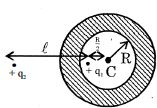
- 6A solid conducting sphere has cavity, as shown in figure. A charge $+ {q_1}$ is situated away from the centre. A charge $+q_2$ is situated outside the sphere then true statement isView Solution
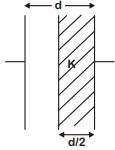
- 7A parallel plate capacitor having crosssectional area $A$ and separation $d$ has air in between the plates. Now an insulating slab of same area but thickness $d/2$ is inserted between the plates as shown in figure having dielectric constant $K (=4) .$ The ratio of new capacitance to its original capacitance will be,View Solution
- 8Potential difference between centre $\&$ the surface of sphere of radius $R$ and uniform volume charge density $\rho$ within it will be :View Solution
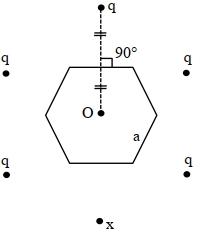
- 9Six charges are placed around a regular hexagon of side length a as shown in the figure. Five of them have charge $q$, and the remaining one has charge $x$. The perpendicular from each charge to the nearest hexagon side passes through the center $O$ of the hexagon and is bisected by the side.View Solution
Which of the following statement($s$) is(are) correct in SI units?
$(A)$ When $x=q$, the magnitude of the electric field at $O$ is zero.
$(B)$ When $x=-q$, the magnitude of the electric field at $O$ is $\frac{q}{6 \pi \epsilon_0 a^2}$.
$(C)$ When $x=2 q$, the potential at $O$ is $\frac{7 q}{4 \sqrt{3} \pi \epsilon_0 a}$.
$(D)$ When $x=-3 q$, the potential at $O$ is $\frac{3 q}{4 \sqrt{3} \pi \epsilon_0 a}$.
- 10Which of the following statement$(s)$ is/are correct?View Solution
$(A)$ If the electric field due to a point charge varies as $r^{-25}$ instead of $r^{-2}$, then the Gauss law will still be valid.
$(B)$ The Gauss law can be used to calculate the field distribution around an electric dipole.
$(C)$ If the electric field between two point charges is zero somewhere, then the sign of the two charges is the same.
$(D)$ The work done by the external force in moving a unit positive charge from point $A$ at potential $V_A$ to point $B$ at potential $V_B$ is $\left(V_B-V_A\right)$.