Question
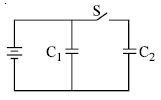
Two capacitors of equal capacitance $(C_1 = C_2)$ are shown in the figure. Initially, while the switch $S$ is open, one of the capacitors is uncharged and the other carries charge $Q_0$. The energy stored in the charged capacitor is $U_0$. Sometimes after the switch is closed, the capacitors $C_1$ and $C_2$ carry charges $Q_1$ and $Q_2$, respectively; the voltages across the capacitors are $ V_1$ and $V_2$; and the energies stored in the capacitors are $U_1$ and $U_2$. Which of the following statements is INCORRECT ? 
Answer

In the above diagram, $C_{1}$ and $C_{2}$ are connected in parallel.

Hence, both get the same voltage. $\therefore V_{1}=V_{2}$ is correct.

We know that $Q_{1}=C_{1} V_{1}$ and $Q_{2}=C_{2} V_{2}$ $\because C_{1}=C_{2}, \quad Q_{1}=Q_{2}$

We know that energy $U_{1}=\frac{1}{2} C_{1} V_{1}^{2}$ and $U_{2}=\frac{1}{2} C_{2} V_{2}^{2}$

By closing the switch, the $C_{1}$ or $V_{1}$ doesn't get affected.

Hence $U_{0}=U_{1}$ and not $U_{1}+U_{2}$

Similarly, By closing the switch, the $Q_{1}$ or $V_{1}$ doesn't get affected.

Hence $Q_{0}=Q_{1}$

$\because Q_{0}=Q_{1}=Q_{2}, \quad Q_{0}=\frac{1}{2}\left(Q_{1}+Q_{2}\right)$

Thus $D$ is the only wrong statement.

Need a full question paper?

Generate a complete, print-ready paper with questions like this in minutes — across 16+ boards, with answer keys.

Start Generating Free

Similar questions

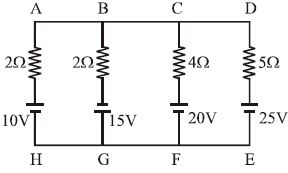
In the given network current through branch $BG$ is almost equal to ............ $A$
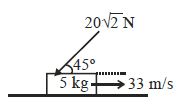
A block of mass $5\, kg$ is kept on a rough horizontal floor. It is given a velocity $33\, m/s$ towards right. A force of $20\sqrt {2\,} \,N$ continuously acts on the block as shown in the figure. If the coefficient of friction between block and floor is $0.5$ the velocity of block after $3\, seconds$ is ........ $m/s$  ($g = 10\, m/s^2$)
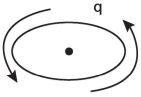
Assertion $(A):$ A charge moving in a circular orbit can produce electromagnetic wave.

Reason $(R):$ The source of electromagnetic wave should be in accelerated motion.

In free space, an electromagnetic wave of $3 \; GHz$ of $3 \; GHz$ frequency strikes over the edge of an object of size $\frac{\lambda}{100}$, where $\lambda$ is the wavelength of the wave in free space. The phenomenon, which happens there will be .....
A cylindrical tube $(L = 120\,cm.)$ is resonant with a tuning fork of frequency $330\,Hz$. If it is filling by water then to get resonance minimum length of water column is ..... $cm$ $(V_{air} = 330\,m/s)$
Intensity of light depends upon
A curved in a level road has a radius $75\, m$. The maximum speed of a car turning this curved road can be $30 \,m / s$ without skidding. If radius of curved road is changed to $48\, m$ and the coefficient of friction between the tyres and the road remains same, then maximum allowed speed would be .........$m / s$.
Two similar thin equi-convex lenses, of focallength feach, are kept coaxially in contact with each other such that the focallength of the combination is $\mathrm{F}_{1}$. When the space between the two lenses is filled with gyoern(which has the same refractive index ( $\mu =1.5$ ) as that of glass then the equivalent focal length is $\mathrm{F}_{2} .$ The ratio $\mathrm{F}_{1}: \mathrm{F}_{2}$ will be


A circular coil of $1000\,turns$ and area of cross-section $1.5 \times 10^{-4}\, m^2$, is carrying a current of $2\,A$. What is the magnetic moment associated with the coil?....$Am^2$
A beaker containing a liquid of density $\rho $ moves up with an acceleration $a$ ; the pressure due to the liquid at a depth $h$ below the free surface of the liquid is