MCQ
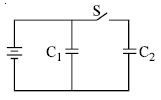
Two capacitors of equal capacitance $(C_1 = C_2)$ are shown in the figure. Initially, while the switch $S$ is open, one of the capacitors is uncharged and the other carries charge $Q_0$. The energy stored in the charged capacitor is $U_0$. Sometimes after the switch is closed, the capacitors $C_1$ and $C_2$ carry charges $Q_1$ and $Q_2$, respectively; the voltages across the capacitors are $ V_1$ and $V_2$; and the energies stored in the capacitors are $U_1$ and $U_2$. Which of the following statements is INCORRECT ?
- A$Q_0$ $=$ $\frac{1}{2}$ $(Q_1 + Q_2)$
- B$Q_1 = Q_2$
- C$V_1 = V_2$
- ✓$U_0 = U_1 + U_2$