MCQ
Two capillaries of same length and radii in the ratio $1 : 2$  are connected in series. A liquid flows through them in streamlined condition. If the pressure across the two extreme ends of the combination is $ 1 m$  of water, the pressure difference across first capillary is...... $m$
  • A
    $9.4 $
  • B
    $4.9 $ 
  • C
    $0.49$
  • $0.94$

Answer

Correct option: D.
$0.94$
d
(d)Given, ${l_1} = {l_2} = 1,$and $\frac{{{r_1}}}{{{r_2}}} = \frac{1}{2}$
$V = \frac{{\pi {P_1}r_1^4}}{{8\eta l}} = \frac{{\pi {P_2}r_2^4}}{{8\eta l}}$==> $\frac{{{P_1}}}{{{P_2}}} = {\left( {\frac{{{r_2}}}{{{r_1}}}} \right)^4} = 16$
==> ${P_1} = 16{P_2}$
Since both tubes are connected in series, hence pressure difference across combination,
$P = {P_1} + {P_2}$==> 1 = ${P_1} + \frac{{{P_1}}}{{16}}$ ==> ${P_1} = \frac{{16}}{{17}} = 0.94m$

Need a full question paper?

Generate a complete, print-ready paper with questions like this in minutes — across 16+ boards, with answer keys.

Start Generating Free

Similar questions

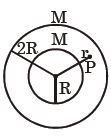
Two concentric hollow sphere of radius $R$ and $2R$ and same mass $M$ as shown in figure then gravitational field intensity at point $P$ is
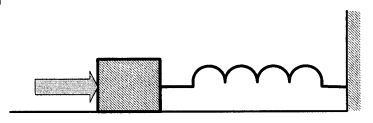
A block of mass $0.18 \ kg$ is attached to a spring of force-constant $2 \ N / m$. The coefficient of friction between the block and the floor is $0.1$ . Initially the block is at rest and the spring is un-stretched. An impulse is given to the block as shown in the figure. The block slides a distance of $0.06 \ m$ and comes to rest for the first time. The initial velocity of the block in $m / s$ is $V = N / 10$. Then $N$ is
On sounding tuning fork $A$ with another tuning fork $B$ of frequency $384 Hz, 6$ beats are produced per second. After loading the prongs of $A$ with some wax and then sounding it again with $B, 4$ beats are produced per second. What is the frequency of the tuning fork $A$  .... $Hz$
A body of mass $1\,kg$ is projected with velocity $50\,m / s$ at an angle of $30^{\circ}$ with the horizontal. At the highest point of its path a force $10\,N$ starts acting on body for $5\,s$ vertically upward besides gravitational force, what is horizontal range of the body? $\left(g=10\,m/s^2\right)$
A stone is allowed to fall freely from rest. The ratio of the time taken to fall through the first meter and the second meter distance is:
A glass flask is filled up to a mark with $50\, cc$ of mercury at $18°C.$ If the flask and contents are heated to $38°C.$ ......... $cc$ mercury will be above the mark $?$ $(\alpha$ for glass is $ 9 × 10^{-6}{°}C^{-1}$ and coefficient of real expansion of mercury is $180 × 10^{-6}{°}C^{-1})$ 
The radius of gyration of a uniform rod of length $L$ about an axis passing through its centre of mass is:
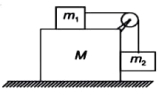
In the given arrangement all surfaces are smooth. What acceleration should be given to the system, for which the block $m_2$ doesn't slide down?
The ends of a stretched wire of length $L$ are fixed at $x = 0$ and $x = L.$ In one experiment, the displacement of the wire is ${y_1} = A\sin (\pi x/L)\sin \omega t$ and energy is ${E_1}$, and in another experiment its displacement is ${y_2} = A\sin (2\pi x/L)\sin 2\omega t$ and energy is ${E_2}$. Then
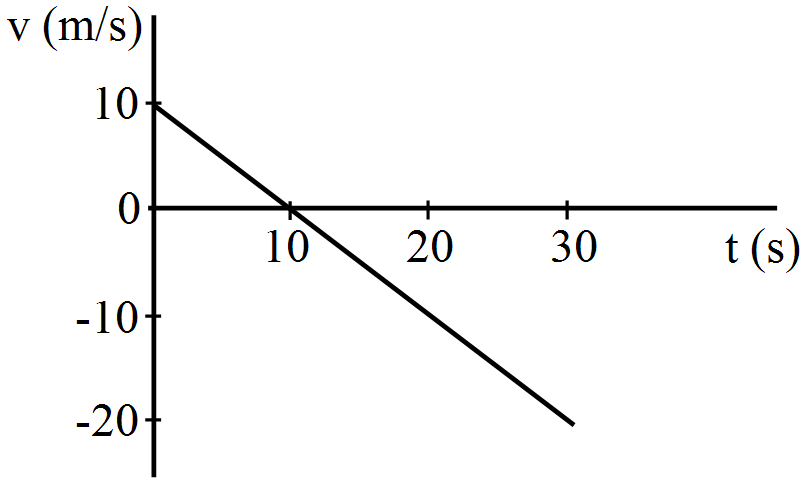
The velocity$-$time plot for a particle moving on a straight line is shown in the figure: