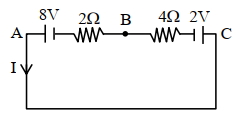
Two cells are connected in opposition as shown. Cell $\mathrm{E}_1$ is of $8 \mathrm{~V}$ emf and $2 \ \Omega$ internal resistance; the cell $E_2$ is of $2 \mathrm{~V}$ emf and $4\ \Omega$ internal resistance. The terminal potential difference of cell $\mathrm{E}_2$ is:
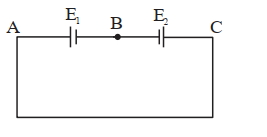
JEE MAIN 2024, Diffcult


Download our appand get started for free
Experience the future of education. Simply download our apps or reach out to us for more information. Let's shape the future of learning together!No signup needed.*
Similar Questions
- 1Two metal wires of identical dimensions are connected in series. If $\sigma _1$ and $\sigma _2$ are the conductivities of the metal wires respectively, the effective conductivity of the combination isView Solution
- 2View SolutionWhen a piece of aluminium wire of finite length is drawn through a series of dies to reduce its diameter to half its original value, its resistance will become ........ times
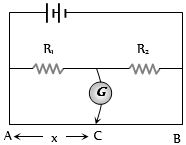
- 3In the shown arrangement of the experiment of the meter bridge if $AC$ corresponding to null deflection of galvanometer is $x$, what would be its value if the radius of the wire $AB$ is doubledView Solution
- 4A current of $2\, A$ passing through conductor produces $80\, J$ of heat in $10$ seconds. The resistance of the conductor is ............ $\Omega$View Solution
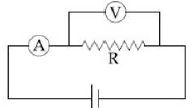
- 5The actual value of resistance $R$, shown in the figure is $30\,\Omega $. This is measured in an experiment as shown using the standard formula $R = \frac{V}{I}$ where $V$ and $I$ are the readings of the voltmeter and ammeter, respectively. If the measured value of $R$ is $5\%$ less, then the internal resistance of the voltmeter is ................. $\Omega$View Solution
- 6$10$ resistors, each of resistance $R$ are connected in series to a battery of $emf$ $E$ and negligible internal resistance. Then those are connected in parallel to the same battery, the current is increased $n$ times. The value of $n$ is :View Solution
- 7If the current through a resistor in a circuit increases by $3 \%$, then the power dissipated by the resistorView Solution
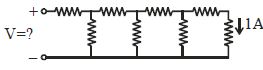
- 8Each element in the finite chain of resistors shown in the figure is $1\,\Omega $. A current of $1\, A$ flows through the final element. Then what is the potential difference $V$ across input terminals of the chain ............... $\mathrm{volt}$View Solution
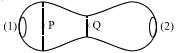
- 9Ametallic conductor of irregular cross-section is as shown in the figure. Aconstant potential difference is applied across the ends $(1)$ and $(2)$. Then :View Solution
- 10The effective resistance of a parallel connection that consists of four wires of equal length, equal area of cross-section and same material is $0.25\, \Omega$. What will be the effective resistance if they are connected in series ? (In $\Omega$)View Solution