A current of $2\, A$ passing through conductor produces $80\, J$ of heat in $10$ seconds. The resistance of the conductor is ............ $\Omega$
AIPMT 1989, Easy


Download our appand get started for free
Experience the future of education. Simply download our apps or reach out to us for more information. Let's shape the future of learning together!No signup needed.*
Similar Questions
- 1It is preferable to measure the $e.m.f.$ of a cell by potentiometer than by a voltmeter because of the following possible reasons.View Solution
$(i)$ In case of potentiometer, no current flows through the cell.
$(ii)$ The length of the potentiometer allows greater precision.
$(iii)$ Measurement by the potentiometer is quicker.
$(iv)$ The sensitivity of the galvanometer, when using a potentiometer is not relevant.
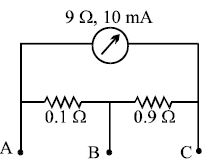
Which of these reasons are correct? - 2A milliammeter of range $10\, mA$ and resistance $9\, \Omega$ is joined in a circuit as shown. The meter gives full-scale deflection for current $I$ when $A$ and $B$ are used as its terminals, i.e., current enters at $A$ and leaves at $B$ ($C$ is left isolated). The value of $I$ isView Solution
- 3Match the List $I$ with the List $II$ from the combination shown. In the left side (List $I$) there are four different conditions and in the right side (List $II$), there are ratios of heat produced in each resistance for each condition :View Solution
List $I$ List $II$ $(I)$ Two wires of same resistance are connected in series and same current is passed through them $(A)$ $1:2$ $(II)$ Two wires of resistance $R$ and $2R$ $ohm$ are connected in series and same $P . D .$ is applied across them $(B)$ $4:1$ $(III)$ Two wires of same resistance are connected in parallel and same current is flowing through them $(C)$ $1:1$ $(IV)$ Two wires of resistances in the ratio $1: 2$ are connected in parallel and same $P . D .$ is applied across the $(D)$ $2:1$ - 4Two bulbs of $(40 \;W, 200\; V)$ and $(100\; W, 200 \;V)$. Then correct relation for their resistanceView Solution
- 5Two solid conductors are made up of same material, have same length and same resistance. One of them has a circular cross section of area $A_{1}$ and the other one has a square cross section of area $A_{2}$. The ratio $\frac{A _{1}}{A _{2}}$ isView Solution
- 6Two equal resistances when connected in series to a battery, consume electric power of $60\,W.$ If these resistances are now connected in parallel combination to the same battery, the electric power consumed will be .............. $W$View Solution
- 7If $2.2\, Kwatt$ power is transmitted through a $10\, ohm$ line at $22000\, volt$, the power loss in the form of heat will be ............. $watt$View Solution
- 8Temperature coefficient at $0\,^oC$ is $0.00125\,^oC^{-1}$. At a temperature of $25\,^oC$ its resistance is $1\,\Omega $. Find the temperature at which resistance is $1.2\,\Omega $View Solution
- 9A current through a wire depends on time as $i =\alpha_{0} t +\beta t ^{2}$ where $\alpha_{0}=20 A / s$ and $\beta=8 As ^{-2} .$ Find the charge crossed through a section of the wire in $15 \,s$ (in $C$)View Solution
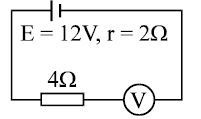
- 10By error, a student places moving-coil voltmeter $V$ (nearly ideal) in series with the resistance in a circuit in order to read the current, as shown. The voltmeter reading will be ............ $V$View Solution