MCQ
Two charged particles traverse identical helical paths in a completely opposite sense in a uniform magnetic field.
  • A
    They have equal $z-$components of momenta.
  • B
    They must have equal charges.
  • C
    They necessarily represent a particle$-$antiparticle pair.
  • The charge to mass ratio satisfy: $\Big(\frac{\text{e}}{\text{m}}\Big)_1+\Big(\frac{\text{e}}{\text{m}}\Big)_2=0$.
Answer

Correct option: D.
The charge to mass ratio satisfy: $\Big(\frac{\text{e}}{\text{m}}\Big)_1+\Big(\frac{\text{e}}{\text{m}}\Big)_2=0$.
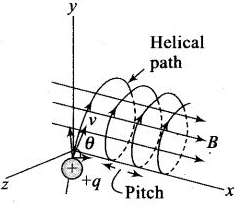
Key concept: In this situation if the particle is thrown in $x-y$ plane $($as shown in figure$)$ at some angle $\theta $ with velocity v, then we have to resolve the velocity of the particle in rectangular components, such that one component is along the field $(v \cos \theta )$ and other one is perpendicular to the field $(v \sin \theta )$. We find that the particle moves with constant velocity $v \cos \theta $ along the field. The distance covered by the particle along the magnetic field is called pitch.


The pitch of the helix, $($i.e., linear distance travelled in one rotation$)$ will be given by
$\text{p}=\text{T}(\text{v}\cos\theta)=2\text{p}\frac{\text{m}}{\text{qB}}(\text{v}\cos\theta)$
For given pitch $p$ correspond to charge particle, we have
$\frac{\text{q}}{\text{m}}=\frac{2\pi\text{v}\cos\theta}{\text{qB}}=\text{constant}$
Here in this case, charged particles traverse identical helical paths in a completely opposite sense in a uniform magnetic field B, $\text{LHS}$ for two particles should be same and of opposite sign. Therefore,
$\Big(\frac{\text{e}}{\text{m}}\Big)_1+\Big(\frac{\text{e}}{\text{m}}\Big)_2=0$

Need a full question paper?

Generate a complete, print-ready paper with questions like this in minutes — across 16+ boards, with answer keys.

Start Generating Free

Similar questions

In the circuit shown in the figure, $C = 6\,\mu F$. The charge stored in the capacitor of capacity $C$ is......$\mu C$
The energy associated with electric field is $(U_E)$ and with magnetic field is $(U_B)$ for an electromagnetic wave in free space. Then
The total current supplied to the circuit by the battery is
Two slits are made one millimetre apart and the screen is placed one metre away. What is the fringe separation (in $mm$) when bluegreen light of wavelength $500\; nm$ is used?
In Young's double slit experiment, the slits are 0.5 mm apart and interference pattern is observed on a screen placed at a distance of 1.0 m from the plane containing the slits. If wavelength of the incident light is 6000 Å, then the separation between the third bright fringe and the central maxima is
In the given circuit the potential difference across resistance is $54\,V$ and power consumed by it is $16\,W$. If $AC$ frequency is $60\,Hz$ find the value of $L$......$H$
The distance between the plates of a parallel plate capacitor is $d$. A metal plate of thickness $d/2$ is placed between the plates. The capacitance would then be
Let $F_{p p} ,F_{p n}$ and $F_{n n}$ fill denote the magnitudes of the nuclear force by a proton on a proton, by a proton on a neutron and by a neutron on a neutron respectively. When the separation is $1$ fm :
A paramagnet magnet behaves like a solenoid because both contain currents in the form of:
In a young's double slit experiment, the fringe pattern is observed on a screen placed at a distance $D$. The slits are separated by $d$ and are illuminated by light of wavelength $\lambda$. Find the distance from the central point where the intensity falls  to half the maximum is