MCQ
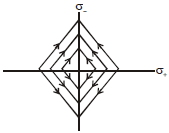
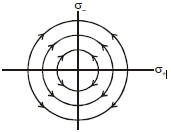
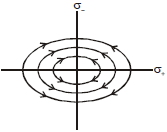
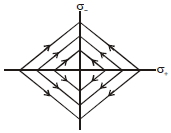
Two charged thin infinite plane sheets of uniform surface charge density $\sigma_{+}$ and $\sigma_{-}$ where $\left|\sigma_{+}\right|>\left|\sigma_{-}\right|$ intersect at right angle. Which of the following best represents the electric field lines for this system

  • B

  • C

  • D

Answer

Correct option: A.

a
Thin infinite uniformly charged planes produces uniform electric field therefore option $2$ and option $3$ are obviously wrong.

And as positive charge density is bigger in magnitude so its field along $Y$ direction will be bigger than field of negative charge in $X$ direction and this is evident in option $1$ so it is correct.

Need a full question paper?

Generate a complete, print-ready paper with questions like this in minutes — across 16+ boards, with answer keys.

Start Generating Free

Similar questions

The image of an extended object, placed perpendicular to the principal axis of a mirror, will be erect if:
Rainbow is formed due to
In the nuclear reaction: $X(n,\,\alpha ){\,_3}L{i^7}$ the term $X$ will be 
A charged water drop whose radius is 0.1 μm is in equilibrium in an electric field. If charge on it is equal to charge of an electron, then intensity of electric field will be (g = 10$ms^{-1}$)
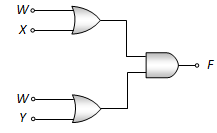
The diagram of a logic circuit is given below. The output F of the circuit is represented by
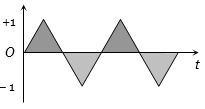
An alternating current of frequency $200\,rad/sec$ and peak value $1\,A$ as shown in the figure, is applied to the primary of a transformer. If the coefficient of mutual induction between the primary and the secondary is $1.5\, H$, the voltage induced in the secondary will be.....$V$
The matter$-$wave picture of electromagnetic wave/radiation elegantly incorporated the:
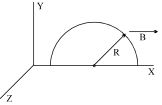
$A$ semicircle conducting ring of radius $R$ is placed in the $xy$ plane, as shown in the figure. $A$ uniform magnetic field is set up along the $x$ -axis. No $emf$, will be induced in the ring. if
A circular loop of radius $0.3\,cm$ lies parallel to a much bigger circular loop of radius $20\,cm$. The centre of the smaller loop is on the axis of the bigger loop. The distance between their centres is $15\,cm$. If a current of $2.0\,A$ flows through the smaller loop, then the flux linked with bigger loop $.............\times 10^{-11} weber$
What is the total work done on moving a test charge on an equipotential surface?