Question
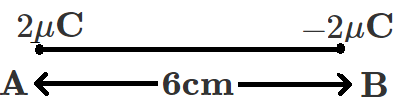
Two charges 2 µC and –2 µC are placed at points A and B 6 cm apart.
  1. Identify an equipotential surface of the system.
  2. What is the direction of the electric field at every point on this surface?
Answer

The situation is represented in the given figure.
  1. An equipotential surface is the plane on which total potential is zero everywhere. This plane is normal to line AB. The plane is located at the mid-point of line AB because the magnitude of charges is the same.
  2. The direction of the electric field at every point on this surface is normal to the plane in the direction of AB.

Need a full question paper?

Generate a complete, print-ready paper with questions like this in minutes — across 16+ boards, with answer keys.

Start Generating Free

Similar questions

When an ideal capacitor is charged by a dc battery, no current flows. However, when an ac source is used, the current flows continuously. How does one explain this, based on the concept of displacement current?
Answer the following question:
Magnifying power of a simple microscope is inversely proportional to the focal length of the lens. What then stops us from using a convex lens of smaller and smaller focal length and achieving greater and greater magnifying power?
If the short series limit of the Balmer series for hydrogen is $3646 \stackrel{o}{A}$ calculate the atomic number of the element which gives $X-$ ray wavelengths down to $1.0 \stackrel{o}{A}$. Identify the element.
The force between two point charges kept at a distance r apart in air is F. If the same charges are kept in water at the same distance, how does the force between them change?
As the wavelength is increased from violet to red, the luminosity:
  1. Continuously increases.
  2. Continuously decreases.
  3. Increases then decreases.
  4. Decreases then increases.
Find the cutoff wavelength for the continuous X-rays coming from an X-ray tube operating at 30kV.
Plot a graph showing the variation of coulomb force (F) versus$\bigg(\frac{1}{\text{r}^{2}}\bigg)$; where r is the distance between the two charges of each pair of charges: (1 μC, 2 μC) and (2 μC, – 3 μC). Interpret the graphs obtained.
In the given circuit, assuming point A to be at zero potential, use Kirchhoff's rules to determine the potential at point B.
State factors on which the resistance of a conductor depends.
Show that if the room temperature changes by a small amount from T to $\text{T}+\triangle\text{T},$ the fundamental frequency of an organ pipe changes from v to $\text{v}+\triangle\text{v},$ where-$\frac{\triangle\text{v}}{\text{v}}=\frac{1}{2}\frac{\triangle\text{T}}{\text{T}}.$