Question
Two charges -q each are separated by distance 2d. A third charge +q is kept at mid point O. Find potential energy of +q as a function of small distance x from O due to -q charges. Sketch P.E. v/s x and convince yourself that the charge at O is in an unstable equilibrium.
Answer

$\text{U}=\frac{1}{4\pi\epsilon_0}\left\{\frac{-\text{q}^2}{(\text{d}-\text{x})}+\frac{-\text{q}^2}{(\text{d}+\text{x})}\right\}$
$\Rightarrow\ \text{U}=\frac{-\text{q}^2}{4\pi\epsilon_0}\frac{2\text{q}}{(\text{d}^2-\text{x}^2)}$
$\Rightarrow\ \frac{\text{dU}}{\text{dx}}=\frac{-\text{q}^2 2\text{d}}{4\pi\epsilon_0}\frac{2\text{x}}{(\text{d}^2-\text{x}^2)^2}$
Here, $\frac{\text{dU}}{\text{dx}}=0$ at x = 0
x is an equilibrium point.
$\frac{\text{d}^2\text{U}}{\text{dx}^2}=\bigg(\frac{-2\text{dq}^2}{4\pi\epsilon_0}\bigg)\Bigg[\frac{2}{(\text{d}^2-\text{x}^2)^2}-\frac{8\text{x}^2}{(\text{d}^2-\text{x}^2)^3}\Bigg]$
$=\bigg(\frac{-2\text{dq}^2}{4\pi\epsilon_0}\bigg)\frac{1}{(\text{d}^2-\text{x}^2)^3}\bigg[2(\text{d}^2-\text{x}^2)^2-8\text{x}^2\bigg]$
At, x = 0
$\frac{\text{d}^2\text{U}}{\text{dx}^2}=\bigg(\frac{-2\text{dq}^2}{4\pi\epsilon_0}\bigg)\bigg(\frac{1}{\text{d}^6}\bigg)(2\text{d}^2),\text{ which is}<0$
So, unstable equilibrium.

Need a full question paper?

Generate a complete, print-ready paper with questions like this in minutes — across 16+ boards, with answer keys.

Start Generating Free

Similar questions

A particle is moving at a constant speed V from a large distance towards a concave mirror of radius R along its principal axis. Find the speed of the image formed by the mirror as a function of the distance x of the particle from the mirror.
A charge $Q$ located at a point $\vec{\text{r}}$ is in equilibrium under the combined electric field of three charges $q_1, q_2, q_3.$ If the charges $q_1, q_2$ are located at points $\vec{\text{r}}_1$ and $\vec{\text{r}}_2$ respectively, find the direction of the force on $Q,$ due to $q_3$ in terms of $q_1, q_2,$ $\vec{\text{r}}_1,\ \vec{\text{r}}_2$ and $\vec{\text{r}}.$
A hollow tube has a length $l_1$ inner radius $R_1$ and outer radius $R_2$. The material has a thermal conductivity $K$. Find the heat flowing through the walls of the tube if.
  1. The flat ends are maintained at temperatures $T_1$ and $T_2(T_2 > T_1)$
  2. The inside of the tube is maintained at temperature $T_1$ and the outside is maintained at $T_2.$
A small block of mass $200g$ is kept at the top of a frictionless incline which is $10m$ long and $3.2m$ high. How much work was required.
  1. To lift the block from the ground and put it at the top.
  2. To slide the block up the incline? What will be the speed of the block when it reaches the ground.
  3. It falls off the incline and drops vertically on the ground.
  4. It slides down the incline? Take g $= 10m/s^2.$
What is polaroid? Write its uses.
Draw the complete I-V characteristic curve for an ideal P-N junction diode. Define the dynamic resistance in the forward bias state.
When a proton is released from rest in a room, it starts with an initial acceleration $a_0$ towards west. When it is projected towards north with a speed $v_0,$ it moves with an initial acceleration $3a_0$ towards west. Find the electric field and the maximum possible magnetic field in the room.
An aluminium can of cylindrical shape contains $500\ cm^{3}$ of water. The area of the inner cross section of the can is $125\ cm^2.$ All measurements refer to $10^\circ C$. Find the rise in the water level if the temperature increases to $80^\circ C$. The coefficient of linear expansion of aluminium $= 23 \times 10^{-6^\circ} C^{-1}$ and the average coefficient of volume expansion of water $= 3.2 \times 10^{-4\circ} C^{-1}$ respectively.
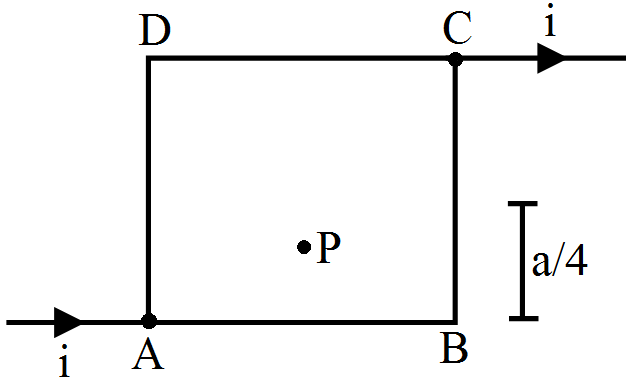
Figure shows a square loop of edge a made of a uniform wire. A current i enters the loop at the point A and leaves it at the point C. Find the magnetic field at the point P which is on the perpendicular bisector of AB at a distance $\frac{\text{a}}{4}$ from it.
Describe the main difference between Fraunhofer and Fresnel's diffraction.