Question
What is polaroid? Write its uses.

Answer

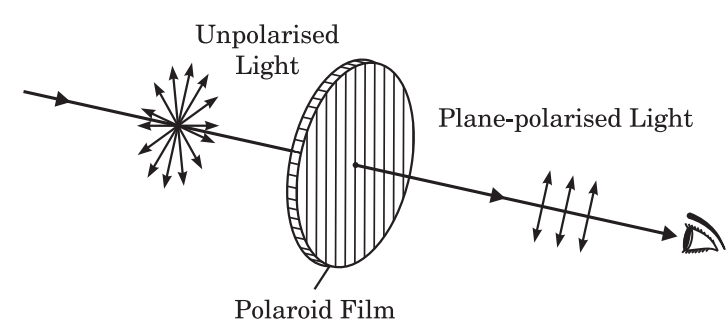
Polaroid : It is a cheap and commercial device for producing plane polarised light. Herapathite is used as raw material in the manufacture of polaroids (by Polaroid Corporation in America). There are a number of methods of preparing polaroid sheets. One method, is said to consist of first breaking up the mineral herapathite into needle like microcrystals and forming a suspension of these in introcellulose. This is then forced through a horizontal slit and the thin sheet coming through the slit is mounted between two thin sheets of glass.
Image
In a polaroid film, all the dichroic crystals are arranged in such a way that the optic axes of all the crystals are parallel. These crystals are highly dichroic, absorbing one of the doubly-refracted beams completely. Each polaroid film has a characteristic direction which is called the 'polarising direction'. In adjacent Fig., this direction is shown by parallel lines.
Uses of Polaroid : (i) One of the main uses of polaroids is to avoid the glare of light. The light reflected from bright surfaces such as wet roads, cover glasses of paintings, polished tables, glazed and white paper, is partially plane-polarised with vibrations in the horizontal plane. This light on reaching the eye produces glare. (It is for this reason that our eye experience glare while reading a book of glazed paper. The glare can be avoided by wearing polarised sun-glasses with their vibration-planes vertical. Then most of the polarised light reflected from the objects will be cut-off. (We see the objects in diffused light.)
(ii) Polaroids are used in motor-cars to avoid the dazzling light of a car approaching from the opposite direction. For this, the polaroids are fitted on the cover glasses of the head-light and the wind screen of the vehicle.
(iii) Sometimes we are not able to see properly very minute particles through a microscope due to glare. Then microscopes fitted with polaroids are used.
(iv) Distinct photographs of clouds can be taken by fitting polaroids in front of the camera-lens. Generally, since the scattered light is always present in the atmos-phere, we cannot take distinct photograph of clouds due the light reflected from the clouds. Since the scattered light is partially-polarised, it is mostly cut off by the polaroid fitted in the camera; while the light reflected from the clouds, being unpolarised, enters the camera. Thus, the background becomes sufficiently dark against which a clear photograph of white clouds is obtained.
(v) Polaroids are used to control the intensity of light entering trains and aeroplanes. For this, one polaroid is fitted outside the window and the other is fitted inside which can be rotated. The intensity of light can be adjusted by rotating the inner polaroid.
(vi) Polaroid glasses are used for viewing three-dimensional pictures.
(vii) Polaroids are used in studying optical properties of metals and in analyzing crystals.
(viii) Polaroids can be used to distinguish between unpolarised, partially plane polarised and completely plane polarised light with the help of a polaroid.
Need a full question paper?

Generate a complete, print-ready paper with questions like this in minutes — across 16+ boards, with answer keys.

Start Generating Free

Similar questions

What is interference of light? Write two essential conditions for sustained interference pattern to be produced on the screen.
Draw a graph showing the variation of intensity versus the position on the screen in Young’s experiment when (a) both the slits are opened and (b) one of the slits is closed.
What is the effect on the interference pattern in Young’s double slit experiment when:
  1. Screen is moved closer to the plane of slits?
  2. Separation between two slits is increased?
Explain your answer in each case.
Find the speed of an electron with kinetic energy:
  1.  1eV
  2. 10keV
  3. 10MeV
A gun of mass M fires a bullet of mass m with a horizontal speed V. The gun is fitted with a concave mirror of focal length f facing tpwards the receding bullet. Find the speed of separation of the bullet and the image just after the gun was fired.
A wire in the form of a tightly wound solenoid is connected to a DC source, and carries a current. If the coil is stretched so that there are gaps between successive elements of the spiral coil, will the current increase or decrease? Explain.
Write advantages and disadvantages of ac over dc and explain applied ac voltage over resistor.
Suppose all the electrons of $100g$ water are lumped together to form a negatively charged particle and all the nuclei are lumped together to form a positively charged particle. If these two particles are placed $10.0\ cm$ away from each other, find the force of attraction between them. Compare it with your weight.
A thin paper of thickness $0.02\ mm$ having a refractive index $1.45$ is pasted across one of the slits in a Young's double slit experiment. The paper transmits $\frac{4}{9}$ of the light energy falling on it.
  1. Find the ratio of the maximum intensity to the minimum intensity in the fringe pattern.
  2. How many fringes will cross through the centre if an identical paper piece is pasted on the other slit also? The wavelength of the light used is 600nm.
A long wire carrying a current i is bent to form a plane angle $\alpha.$ Find the magnetic field B at a point on the bisector of this angle situated at a distance x from the vertex.
A body of mass m makes an elastic collision with another identical body at rest. Show that if the collision is not head $-$ on, the bodies go at right angle to each other after the collision.
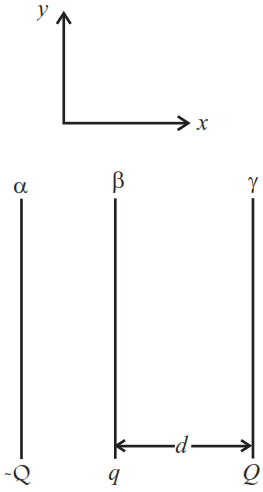
Two fixed, identical conducting plates $(\alpha\ \ \ \beta)$, each of surface area $S$ are charged to $-Q$ and $q,$ respectively, where $Q > q > 0$. A third identical plate $(\gamma)$, free to move is located on the other side of the plate with charge $q$ at a distance $d\ ($Fig.$)$. The third plate is released and collides with the plate $\beta$. Assume the collision is elastic and the time of collision is sufficient to redistribute charge amongst $\beta\ \ \ \gamma$.

Find the velocity of the plate $\gamma$ after the collision and at a distance $d$ from the plate $\beta$.