MCQ
Two closed organ pipes, when sounded simultaneously gave $4$ beats per sec. If longer pipe has a length of $1m$. Then length of shorter pipe will be, ... $cm$ $(v = 300 m/s)$
  • A
    $185.5$
  • $94.9$
  • C
    $90$
  • D
    $80$

Answer

Correct option: B.
$94.9$
b
(b) For first pipe ${n_1} = \frac{v}{{4{l_1}}}$

and for second pipe ${n_2} = \frac{v}{{4{l_2}}}$

So, number of beats = ${n_2} - {n_1} = 4$ 

$ \Rightarrow $$4 = \frac{v}{4}\left( {\frac{1}{{{l_2}}} - \frac{1}{{{l_1}}}} \right)$

$ \Rightarrow $$16 = 300\left( {\frac{1}{{{l_2}}} - \frac{1}{1}} \right)$

$ \Rightarrow $${l_2} = 94.9$$cm$

Need a full question paper?

Generate a complete, print-ready paper with questions like this in minutes — across 16+ boards, with answer keys.
Start Generating Free

Similar questions

In an adiabatic process, the density of a diatomic gas becomes $32$ times its initial value. The final pressure of the gas is found to be $n$ times the initial pressure. The value of $n$ is
When a sound wave of frequency $300 Hz$ passes through a medium the maximum displacement of a particle of the medium is $0.1 cm$. The maximum velocity of the particle is equal to
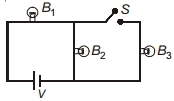
Three identical bulbs $B_1, B_2$ and $B_3$ are connected to the mains as shown in figure. If $B_3$ is disconnected from the circuit by opening switch $S$, then incandescence of bulb $B_1$ will
$X-$ rays of which of the following wavelengths are hardest.........$\mathop A\limits^o $
Two boys are standing at the ends $A$ and $B$ of a ground where $AB = a$. The boy at $B$ starts running in a direction perpendicular to $AB$ with velocity ${v_1}.$ The boy at $A$ starts running simultaneously with velocity $v$ and catches the other boy in a time $t$, where $t$ is
One mole of helium is adiabatically expanded from its initial state $({P_i},{V_i},{T_i})$ to its final state $({P_f},{V_f},{T_f})$. The decrease in the internal energy associated with this expansion is equal to
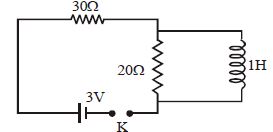
In the circuit (Fig), the final current through $30\, \Omega $ resistance when circuit is completed is.........$A$
If the earth stops rotating, the value of $‘g’$ at the equator will
A homogeneous electric field $E$ and a uniform magnetic field $\mathop B\limits^ \to $ are pointing in the same direction. A proton is projected with its velocity parallel to $\mathop E\limits^ \to $. It will
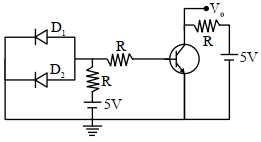
A circuit is arranged as shown in figure. The output voltage ${V}_{0}$ is equal to $\ldots \ldots . {V}$.