MCQ
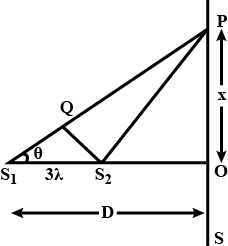
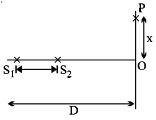
Two coherent narrow slits emitting light of wavelength $\lambda$ in the same phase are placed parallel to each other at a small separation of $3\lambda$ . The light is collected on a screen $S$ which is placed at a distance $D ( > > \lambda )$ from the slits. The smallest distance $x$ such that the $P$ is a maxima
  • A
    $\sqrt {3}D $
  • B
    $\sqrt {8}D $
  • C
    $\sqrt {5}D $
  • $\sqrt 5 \,\frac{D}{2}$

Answer

Correct option: D.
$\sqrt 5 \,\frac{D}{2}$
d
The path difference between the two waves is given by

$\Delta x=2 \lambda=S_{1} P-S_{2} P$

$\Longrightarrow 2 \lambda=S_{1} S_{2} \cos \theta$

Given $S_{1} S_{2}=3 \lambda$ and $\cos \theta=\frac{D}{\sqrt{x^{2}+D^{2}}}$

Hence $3 \lambda \frac{D}{\sqrt{x^{2}+D^{2}}}=2 \lambda$

$\Longrightarrow 9 D^{2}=4\left(x^{2}+D^{2}\right)$

$\Longrightarrow x=\frac{\sqrt{5} D}{2}$

Need a full question paper?

Generate a complete, print-ready paper with questions like this in minutes — across 16+ boards, with answer keys.

Start Generating Free