Question
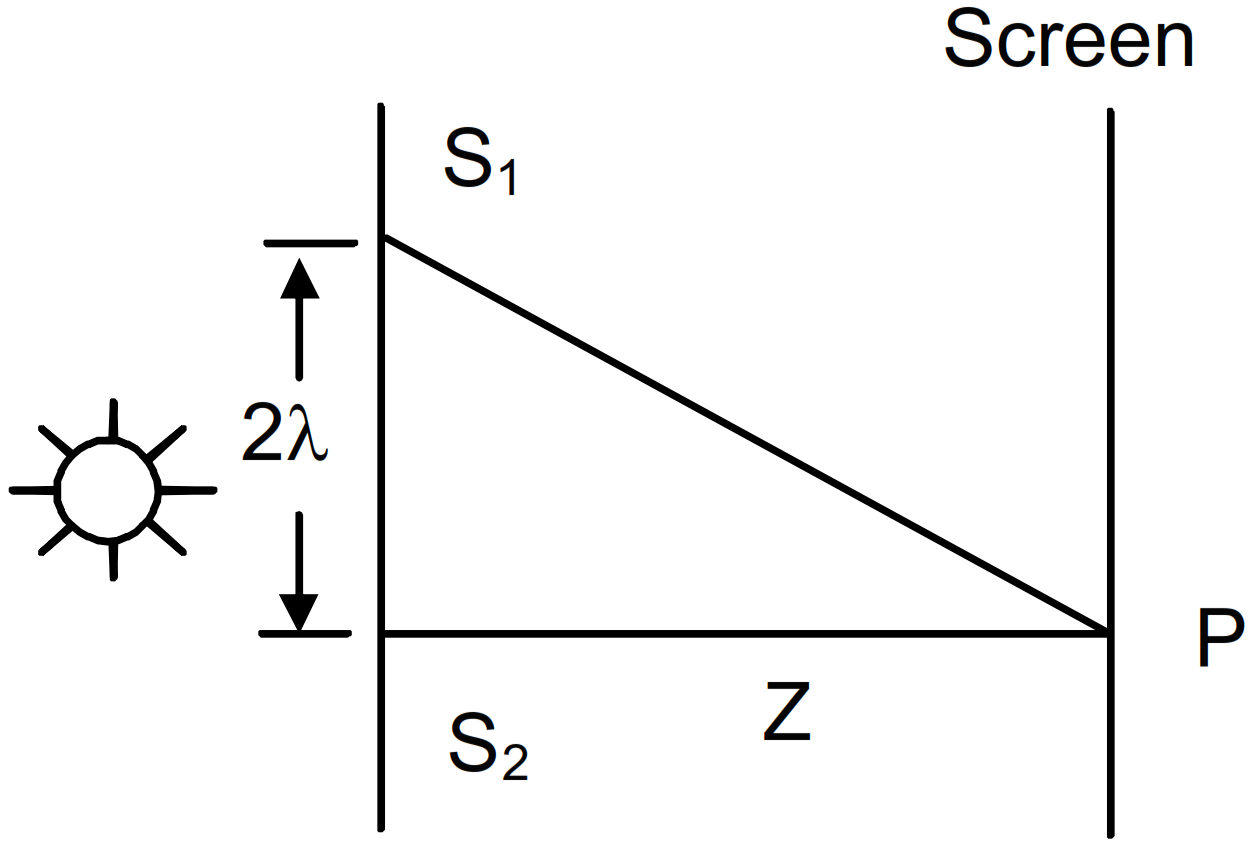
Two coherent point sources S1 and S2 vibrating in phase emit light of wavelength $\lambda$. The separation between the sources is $2\lambda$. Consider a line passing through S2 and perpendicular to the line S1S2. What is the smallest distance from S2 where a minimum of intensity occurs?
Answer

For minimum intensity

$\therefore\text{S}_1\text{P}-\text{S}_2\text{P}=\text{x}=(2\text{n}+1)\frac{\lambda}{2}$

From the figure, we get,

$\Rightarrow\sqrt{\text{X}^2+(2\lambda)^2}-\text{Z}=(2\text{n}+1)\frac{\lambda}{2}$

$\Rightarrow\text{Z}^2+4\lambda^2=\text{Z}^2+(2\text{n}+1)^2\frac{\lambda^2}{4}+\text{Z}(2\text{n}+1)\lambda$

$\Rightarrow\text{Z}=\frac{4\lambda^2-(2\text{n}+1)^2\Big(\lambda^2{4}\Big)}{(2\text{n}+1)\lambda}=\frac{16\lambda^2-(2\text{n}+1)^2\lambda^2}{4(2\text{n}+1)\lambda}\ ...(1)$

Putting, $\text{n}=0\Rightarrow\text{Z}=\frac{15\lambda}{4}$

$\text{n}=-1\Rightarrow\text{Z}=\frac{-15\lambda}{4}$

$\text{n}=1\Rightarrow\text{Z}=\frac{7\lambda}{12}$

$\text{n}=2\Rightarrow\text{Z}=\frac{-9\lambda}{20}$

$\therefore\text{Z}=\frac{7\lambda}{12}$ is the smallest distance for which there will be minimum intensity.

Need a full question paper?

Generate a complete, print-ready paper with questions like this in minutes — across 16+ boards, with answer keys.

Start Generating Free

Similar questions

On an open ground, a motorist follows a track that turns to his left by an angle of $60^{\circ}$ after every 500 m . Starting from a given turn, specify the displacement of the motorist at the third, sixth and eighth turn. Compare the magnitude of the displacement with the total path length covered by the motorist in each case.
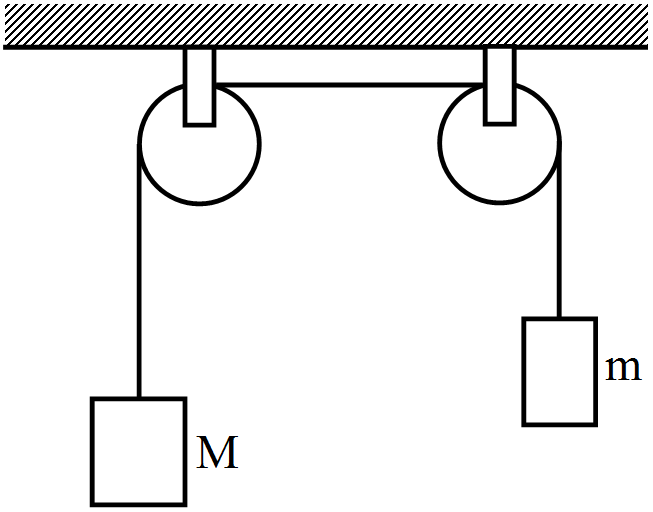
The pulleys in figure are identical, each having a radius R and moment of inertia I. Find the acceleration of the block M.

It is 260km from Patna to Ranchi by air and 320km by road. An aeroplane takes 30 minutes to go from Patna to Ranchi whereas a delux bus takes 8 hours.
  1. Find the average speed of the plane.
  2. Find the average speed of the bus.
  3. Find the average velocity of the plane.
  4. Find the average velocity of the bus.
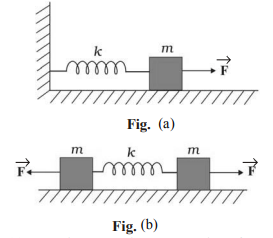
Figure (a) shows a spring of force constant $k$ clamped rigidly at one end and a mass $m$ attached to its free end. A force $F$ applied at the free end stretches the spring. Figure (b) shows the same spring with both ends free and attached to a mass $m$ at either end. Each end of the spring in Fig. (b) is stretched by the same force $F$.
Image
(a) What is the maximum extension of the spring in the two cases?
(b) If the mass in Fig. (a) and the two masses in Fig. (b) are released, what is the period of oscillation in each case?
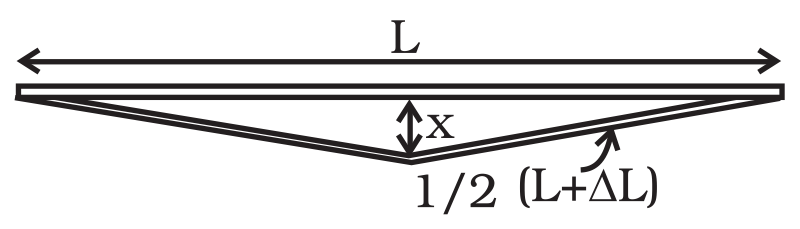
A rail track made of steel having length 10m is clamped on a raillway line at its two ends. On a summer day due to rise in temperature by 20°C , it is deformed as shown in figure. Find x(displacement of the centre) if $\alpha_\text{steel}=1.2\times10^{-5}/{^\circ\text{C}}.$

A ball is dropped from a building of height 45m. Simultaneously another ball is thrown up with a speed 40m/s. Calculate the relative speed of the balls as a function of time.
Use the formula $\text{v}=\sqrt{\frac{\gamma\text{P}}{\rho}}$ to explain why the speed of sound in air:
Is independent of pressure,
A 3m long ladder weighing 20 kg leans on a frictionless wall. Its feet rest on the floor 1 m from the wall as shown in Fig.6.27. Find the reaction forces of the wall and the floor.
The transverse displacement of a string (clamped at its both ends) is given by
$\text{y}(\text{x, t})=0.06\sin\Big(\frac{2\pi}{3}\text{x}\Big)\cos(120\pi\text{ t})$
where x and y are in m and t in s. The length of the string is 1.5m and its mass is 3.0 × 10–2kg.
Answer the following:
Interpret the wave as a superposition of two waves travelling in opposite directions. What is the wavelength, frequency, and speed of each wave?
Explain sound waves and write their properties.