Question
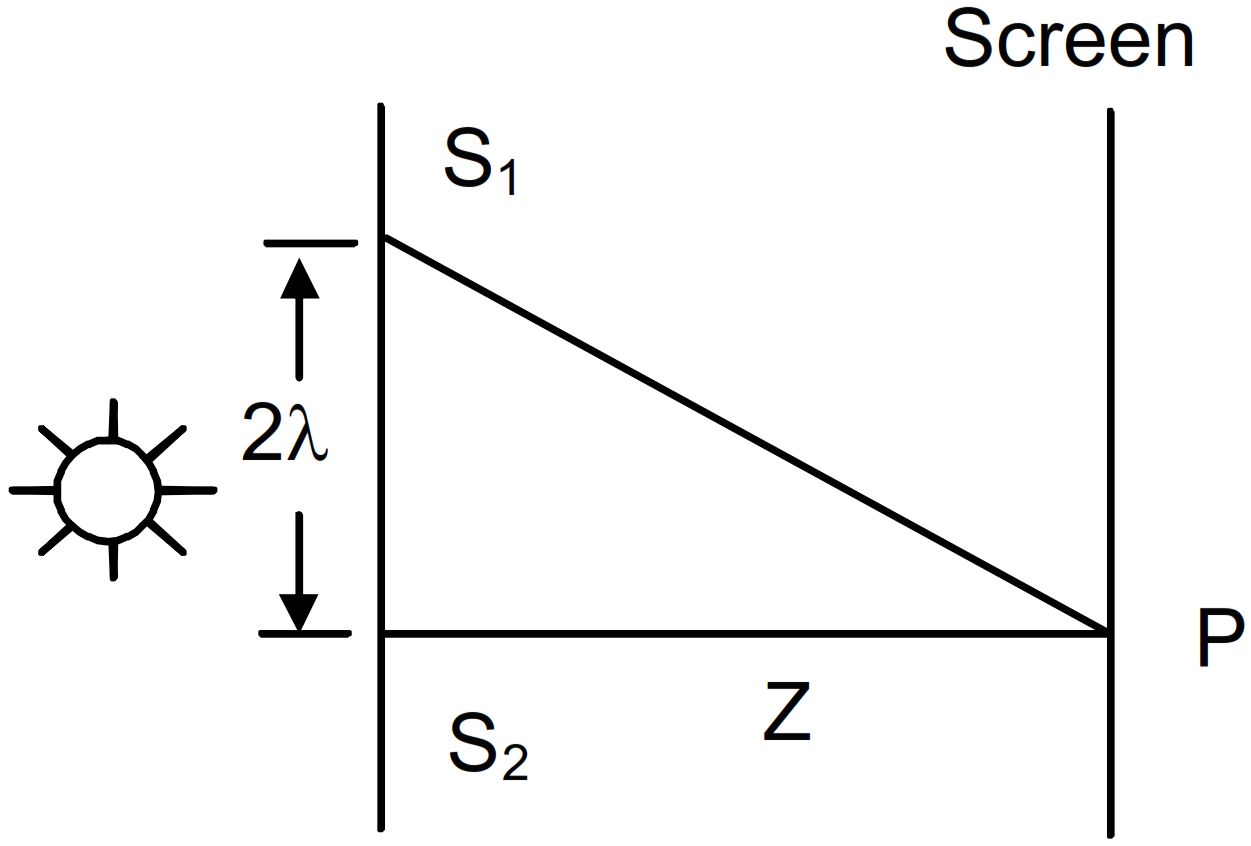
Two coherent point sources $S_1$ and $S_2$ vibrating in phase emit light of wavelength $\lambda$. The separation between the sources is $2 \lambda$. Consider a line passing through $\mathrm{S}_2$ and perpendicular to the line $S_1 S_2$. What is the smallest distance from $S_2$ where a minimum of intensity occurs?
Answer

For minimum intensity

$\therefore\text{S}_1\text{P}-\text{S}_2\text{P}=\text{x}=(2\text{n}+1)\frac{\lambda}{2}$
From the figure, we get,
$\Rightarrow\sqrt{\text{X}^2+(2\lambda)^2}-\text{Z}=(2\text{n}+1)\frac{\lambda}{2}$
$\Rightarrow\text{Z}^2+4\lambda^2=\text{Z}^2+(2\text{n}+1)^2\frac{\lambda^2}{4}+\text{Z}(2\text{n}+1)\lambda$
$\Rightarrow\text{Z}=\frac{4\lambda^2-(2\text{n}+1)^2\Big(\lambda^2{4}\Big)}{(2\text{n}+1)\lambda}=\frac{16\lambda^2-(2\text{n}+1)^2\lambda^2}{4(2\text{n}+1)\lambda}\ ...(1)$
Putting, $\text{n}=0\Rightarrow\text{Z}=\frac{15\lambda}{4}$
$\text{n}=-1\Rightarrow\text{Z}=\frac{-15\lambda}{4}$
$\text{n}=1\Rightarrow\text{Z}=\frac{7\lambda}{12}$
$\text{n}=2\Rightarrow\text{Z}=\frac{-9\lambda}{20}$
$\therefore\text{Z}=\frac{7\lambda}{12}$ is the smallest distance for which there will be minimum intensity.

Need a full question paper?

Generate a complete, print-ready paper with questions like this in minutes — across 16+ boards, with answer keys.

Start Generating Free

Similar questions

Steam at 120°C is continuously passed through a 50cm long rubber tube of inner and outer radii 1.0cm and 1.2cm. The room temperature is 30°C. Calculate the rate of heat flow through the walls of the tube. Thermal conductivity of rubber ${= 0.15Js^{-1}}{m^{-1}}^\circ C^{-1}.$
Two convex lenses, each of focal length 10cm, are placed at a separation of 15cm with their principal axes coinciding,
  1. Show that a light beam coming parallel to the principal axis diverges as it comes out of the lens system.
  2. Find the location of the virtual image formed by the lens system of an object placed far away.
  3. Find the focal length of the equivalent lens.
(Note that the sign of the focal length is positive although the lens system actually diverges a parallel beam incident on it).
Calculate the smallest wavelength of radiation that may be emitted by (a) hydrogen, (b) $He^+$ and (c) $Li^{++}$​​​​​​​
The friction coefficient between the horizontal surface and each of the blocks shown in figure is 0.20. The collision between the blocks is perfectly elastic. Find the separation between the two blocks when they come o rest. Take $g = 10 m/s^2.$
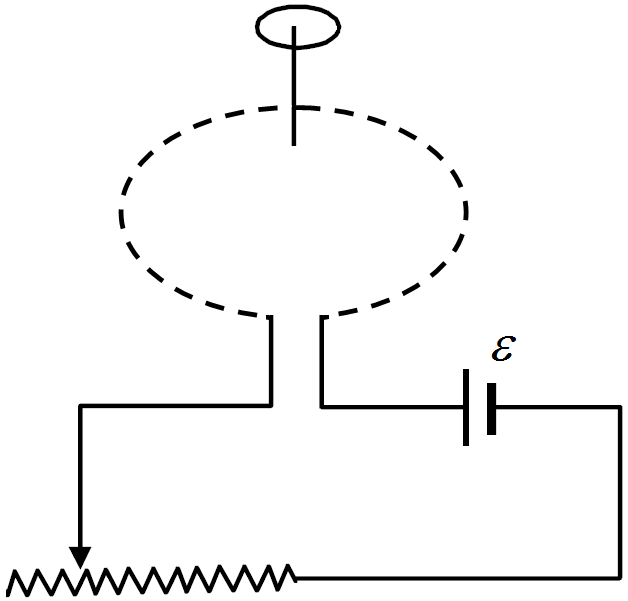
Figure shows a circular coil of N turns and radius a, connected to a battery of emf ϵ through a rheostat. The rheostat has a total length L and resistance R. The resistance of the coil is r. A small circular loop of radius a' and resistance r' is pl-aced coaxially with the coil. The centre of the loop is at a distance x from the centre of coil. the In the beginning, the sliding contact of the rheostat is at the left end and then onwards it is moved towards right at a constant speed u. Find the emf induced in the small circular loop at the instant:
  1. The contact begins to slide.
  2. It has slide through half the length of the rheostat.
Examine the maximum value of magnetic field at a point on the axis of circular current carrying coil after obtaining an expression for it.###Calculate produced magnetic field on the axis of any current carrying circular coil by making diagram. Examine the graph between distance and change in magnetic field after drawing the graph.
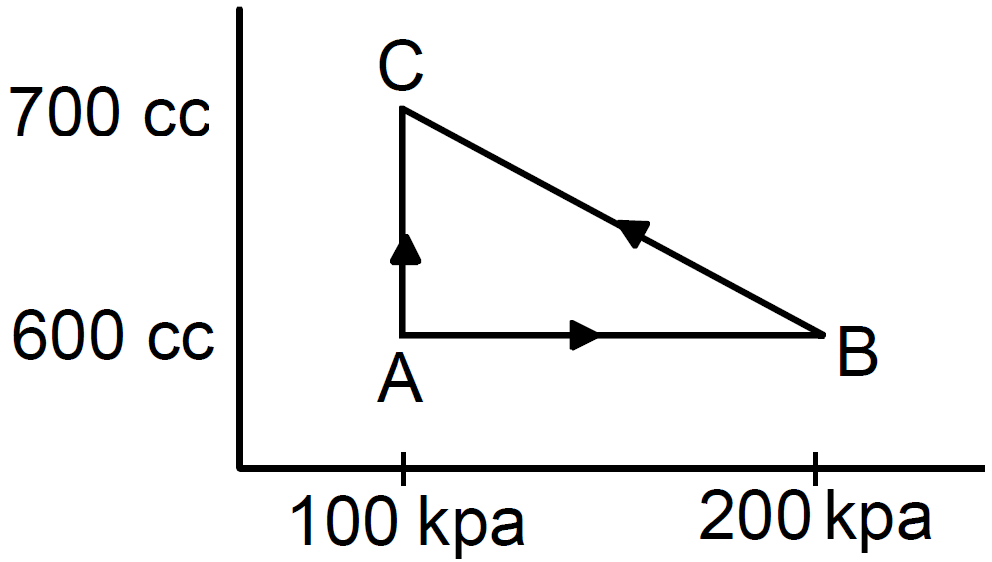
A gas is taken through a cyclic process ABCA as shown in figure. If 2.4 cal of heat is given in the process, what is the value of J?
$a.$ Explain why, for any charge configuration, the equipotential surface through a point is normal to the electric field at that point.
Draw a sketch of equipotential surfaces due to a single charge $(-q)$, depicting the electric field lines due to the charge.
$b.$ Obtain an expression for the work done to dissociate the system of three charges placed at the vertices of an equilateral triangle of side a as shown alongside.
Suppose that the electric field amplitude of an electromagnetic wave is $E_0 = 120$ N/C and that its frequency is $ν = 50.0 $ MHz. (a) Determine, $B_0, ω, k$, and \lambda . (b) Find expressions for E and B.
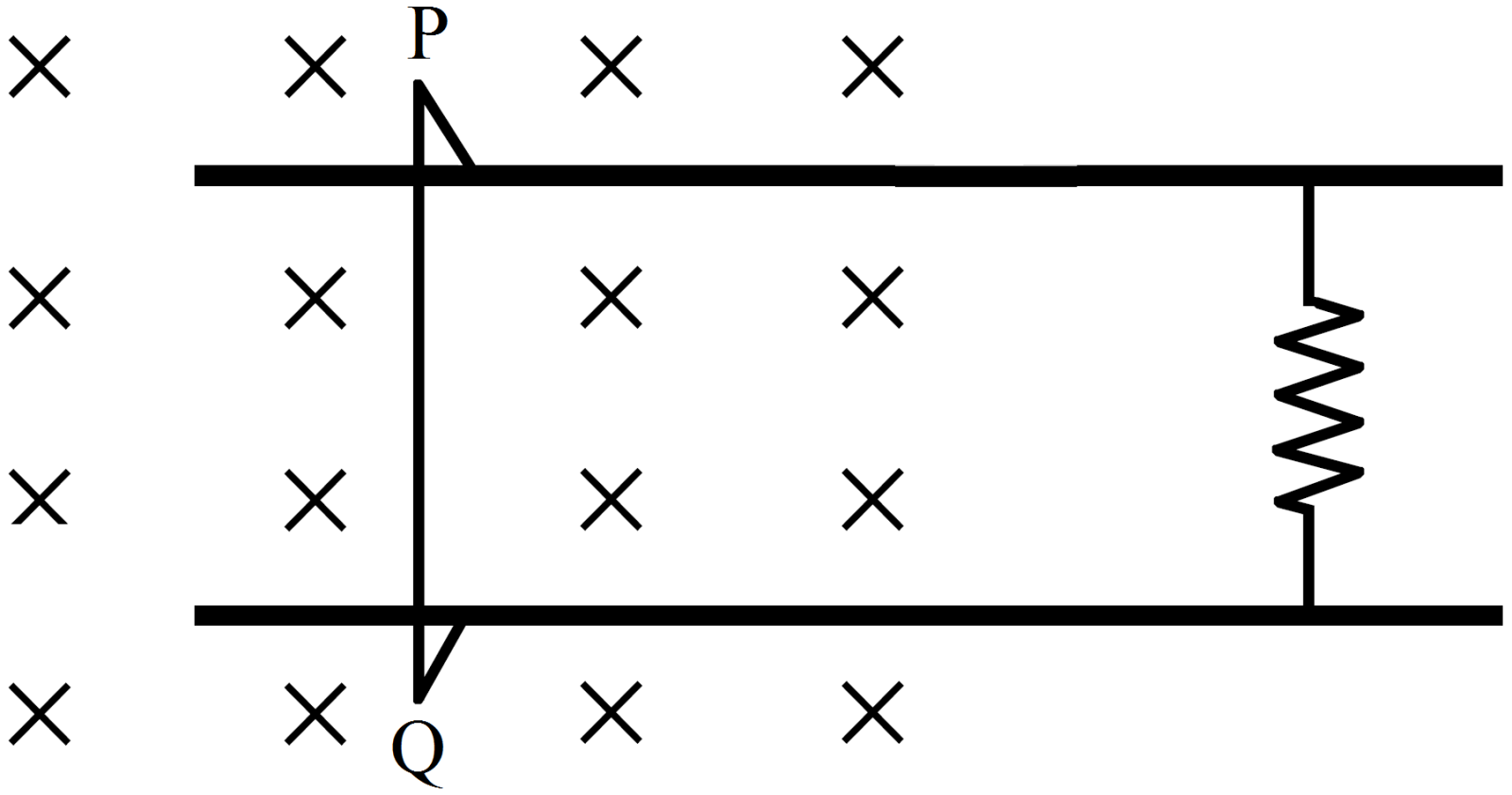
Consider the situation shown in figure. The wire PQ has mass m, resistance r and can slide on the smooth, horizontal parallel rails separated by a distance l. The resistance of the rails is negligible. A uniform magnetic field B exists in the rectangular region and a resistance R connects the rails outside the field region. At t = 0, the wire PQ is pushed towards right with a speed $v_0$. Find
  1. The current in the loop at an instant when the speed of the wire PQ is v.
  2. The acceleration of the wire at this instant.
  3. The velocity vas a functions of x.
  4. The maximum distance the wire will move.