Question
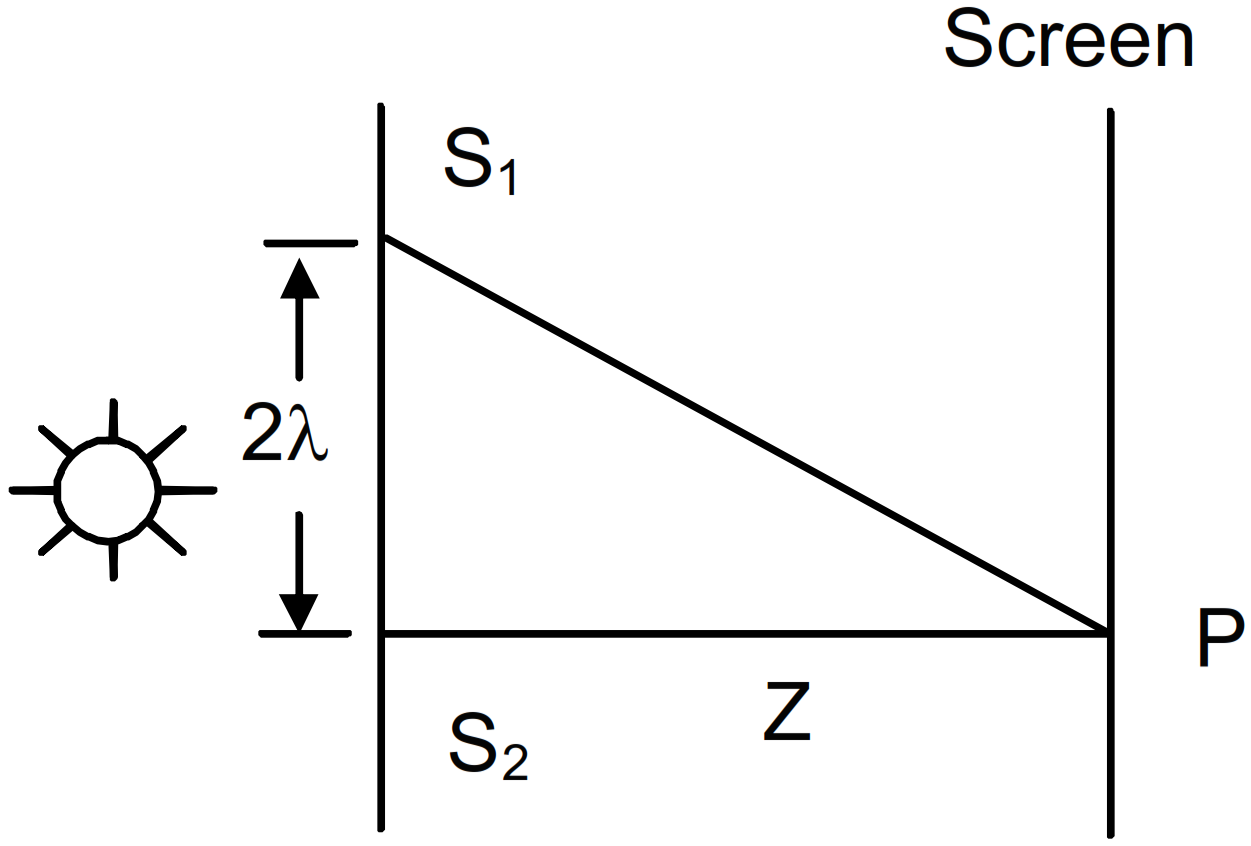
Two coherent point sources $S_1$ and $S_2$ vibrating in phase emit light of wavelength $\lambda$. The separation between the sources is $2\lambda$. Consider a line passing through $S_2$ and perpendicular to the line $S_1S_2$. What is the smallest distance from $S_2$ where a minimum of intensity occurs?
Answer

For minimum intensity

$\therefore\text{S}_1\text{P}-\text{S}_2\text{P}=\text{x}=(2\text{n}+1)\frac{\lambda}{2}$
From the figure, we get,
$\Rightarrow\sqrt{\text{X}^2+(2\lambda)^2}-\text{Z}=(2\text{n}+1)\frac{\lambda}{2}$
$\Rightarrow\text{Z}^2+4\lambda^2=\text{Z}^2+(2\text{n}+1)^2\frac{\lambda^2}{4}+\text{Z}(2\text{n}+1)\lambda$
$\Rightarrow\text{Z}=\frac{4\lambda^2-(2\text{n}+1)^2\Big(\lambda^2{4}\Big)}{(2\text{n}+1)\lambda}=\frac{16\lambda^2-(2\text{n}+1)^2\lambda^2}{4(2\text{n}+1)\lambda}\ ...(1)$
Putting, $\text{n}=0\Rightarrow\text{Z}=\frac{15\lambda}{4}$
$\text{n}=-1\Rightarrow\text{Z}=\frac{-15\lambda}{4}$
$\text{n}=1\Rightarrow\text{Z}=\frac{7\lambda}{12}$
$\text{n}=2\Rightarrow\text{Z}=\frac{-9\lambda}{20}$
$\therefore\text{Z}=\frac{7\lambda}{12}$ is the smallest distance for which there will be minimum intensity.

Need a full question paper?

Generate a complete, print-ready paper with questions like this in minutes — across 16+ boards, with answer keys.

Start Generating Free

Similar questions

The $\text{K}_\alpha$ X-rays of aluminium (Z = 13) and zinc (Z = 30) have wavelengths 887pm and 146pm respectively. Use Moseley's law $\sqrt{\text{v}}=\text{a}(\text{z-b})$ to find the wavelengths of the $\text{K}_\alpha$ X-ray of iron (Z = 26).
Quite often, connecting wires carrying currents in opposite directions are twisted together in using electrical appliances. Explain how it avoids unwanted magnetic fields.
Find the diameter of the image of the moon formed by a spherical concave mirror of focal length 7.6m. The diameter of the moon is 3450km and the distance between the earth and the moon is $3.8 \times 10^5km.$
  1. Draw a labelled ray diagram showing the formation of image by a compound microscope in normal adjustment. Derive the expression for its magnifying power.
  2. How does the resolving power of a microscope change when.
  1. The diameter of the objective lens is decreased,
  2. The wavelength of the incident light is increased.
Justify your answer in each case.
What is called a capacitor? Explain its principle. Find the formula for combination of capacitors in parallel and series.###Define capacitor. Establish the formula of resultant capacitance in its series and parallel combination. Also draw the necessary circuit diagram.###Define capacitor. How can we increase its capacity? Establish the formula for combining capacitors in parallel and series.
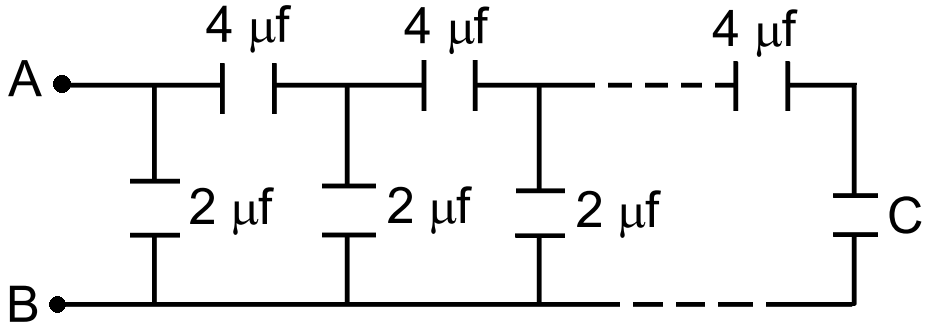
A finite ladder is constructed by connecting several sections of $2\mu\text{F},\ 4\mu\text{F}$ capacitor combinations as shown in figure. It is terminated by a capacitor of capacitance C. What value should be chosen for C, such that the equivalent capacitance of the ladder between the points A and B becomes independent of the number of sections in between?
Monochromatic radiation of wavelength 640.2 nm $(1nm = 10^{–9} m)$ from a neon lamp irradiates photosensitive material made of caesium on tungsten. The stopping voltage is measured to be 0.54 V. The source is replaced by an iron source and its 427.2 nm line irradiates the same photo-cell. Predict the new stopping voltage.
The earth revolves round the sun due to gravitational attraction. Suppose that the sun and the earth are point particles with their existing masses and that Bohr's quantization rule for angular momentum is valid in the case of gravitation. (a) Calculate the minimum radius the earth can have for its orbit. (b) What is the value of the principal quantum number n for the present radius? Mass of the earth $= 6.0 \times 10^{-24}$kg. Mass of the sun $= 2.0 \times 10^{30}$kg, earth-sun distance $= 1.5 \times 10^{11}$m.
A compound microscope consists of an objective lens of focal length 2.0 cm and an eyepiece of focal length 6.25 cm separated by a distance of 15 cm. How far from the objective should an object be placed in order to obtain the final image at (a) the least distance of distinct vision (25 cm), and (b) at infinity? What is the magnifying power of the microscope in each case?
A capacitor of capacitance C is connected to a battery of emf $\in$ at t = 0 through a resistance R. Find the maximum rate at which energy is stored in the capacitor. When does the rate have this maximum value?