- Draw a labelled ray diagram showing the formation of image by a compound microscope in normal adjustment. Derive the expression for its magnifying power.
- How does the resolving power of a microscope change when.
- The diameter of the objective lens is decreased,
- The wavelength of the incident light is increased.
CBSE OUTSIDE DELHI - SET 2 AJMER 2015
Download our app for free and get started
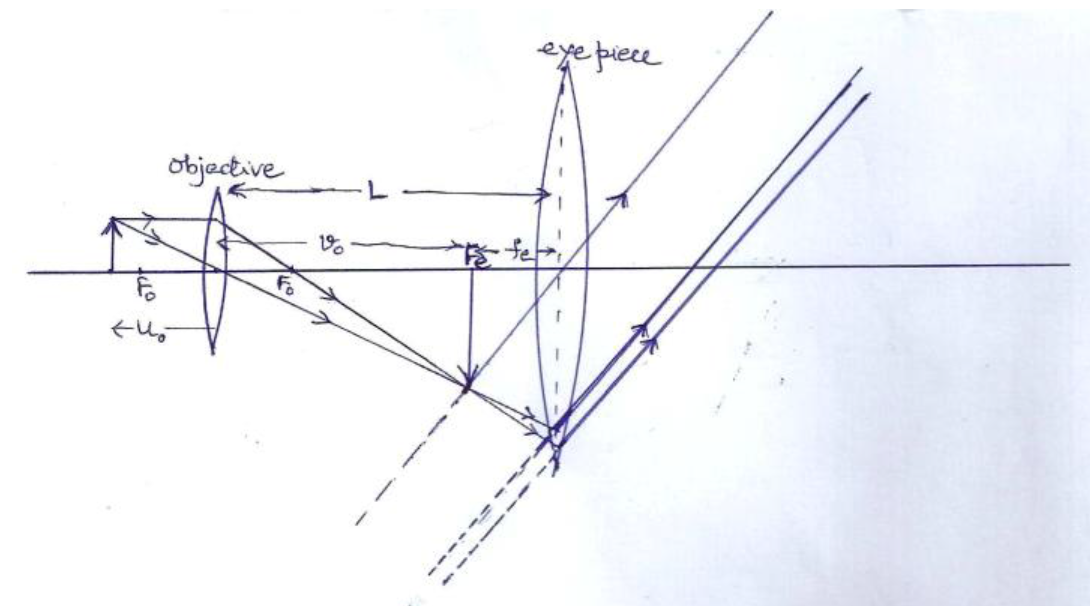
Derivation:
- Magnification due to objective $\text{M}_{\circ} = \frac{\text{L}}{\text{f}_{\circ}}$
- Magnification due to eyelens $\text{M}_{e} = \frac{\text{D}}{\text{f}_{e}}$
- Total magnification m $ = \text{m}_{\circ}\text{m}_{e}$
$\text{m}_{\circ} = \frac{\text{L}}{\text{f}_{\circ}}.\frac{\text{D}}{\text{f}_{e}}$
- The resolving power of microscope.
- Will decrease with decrease of the diameter of objective lens as resolving power is directly proportional to the diameter.
- Will decrease with increase of the wavelength of the incident light as resolving power is inversely proportional to the wave length.

Download our appand get started for free
Experience the future of education. Simply download our apps or reach out to us for more information. Let's shape the future of learning together!No signup needed.*
Similar Questions
- 1View Solution
- A point object is placed on the principal axis of a convex spherical surface of radius of curvature R, which separates the two media of refractive indices $n_1$ and $n_2(n_2 > n_1)$. Draw the ray diagram and deduce the relation between the object distance (u), image distance (v) and the radius of curvature (R) for refraction to take place at the convex spherical surface from rarer to denser medium.
- A converging lens has a focal length of 20 cm in air. It is made of a material of refractive index 1.6. If it is immersed in a liquid of refractive index 1.3, find its new focal length.
- 2View SolutionA point object is placed at a distance of 15cm from a convex lens. The image is formed on the other side at a distance of 30cm from the lens. When a concave lens is placed in contact with the convex lens, the image shifts away further by 30cm. Calculate the focal lengths of the two lenses.
- 3For a glass prism $(\mu=\sqrt{3})$ the angle of minimum deviation is equal to the angle of the prism. Find the angle of the prism.View Solution
- 4View SolutionAn angular magnification (magnifying power) of 30X is desired using an objective of focal length 1.25 cm and an eyepiece of focal length 5 cm. How will you set up the compound microscope?
- 5The radii of curvature of a lens are +20cm and +30cm. The material of the lens has a refracting index 1.6. Find the focal length of the lens.View Solution
- If it is placed in air.
- If it is placed in water $(\mu=1.33).$
- 6View SolutionFigure shows a plane mirror M placed at a distance of 10cm from a concave lens L. A point object is placed at a distance of 60cm from the lens. The image formed due to refraction by the lens and reflection by the mirror is 30cm behind the mirror. What is the focal length of this lens?
- 7View Solution
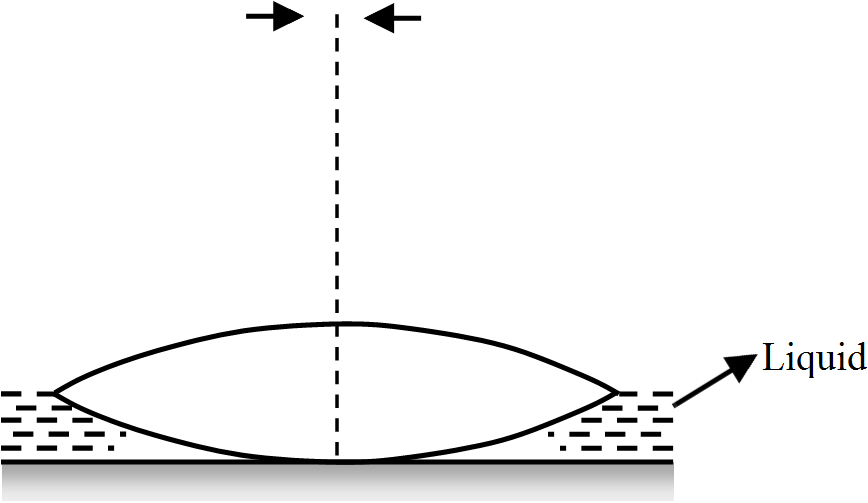
- An equiconvex lens with radii of curvature of magnitude r each, is put over a liquid layer poured on top of a plane mirror. A small needle, with its tip on the principal axis of the lens, is moved along the axis until its inverted real image coincides with the needle itself. The distance of the needle from the lens is measured to be 'a'. On removing the liquid layer and repeating the experiment the distance is found to be 'b'.
- If r = 10cm, a = 15cm, b = 10cm, find the refractive index of the liquid.
- 8A biconvex thick lens is constructed with glass $(\mu=1.50)$ Each of the surfaces has a radius of 10cm and the thickness at the middle is 5cm. Locate the image of an object placed far away from the lens.View Solution
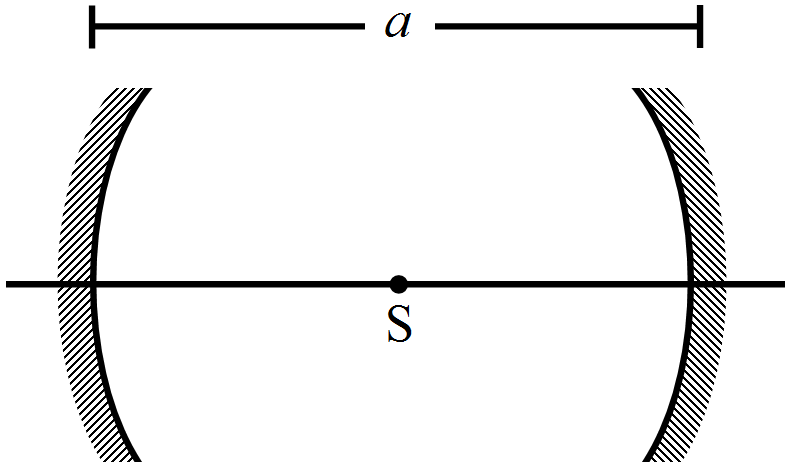
- 9View SolutionA point source S is placed midway between two converging mirrors having equal focal length f. Find the values of d for which only one image is formed.
- 10View SolutionA converging lens of focal length 15cm and a converging mirror of focal length 10cm are placed 50cm apart with common principal axis. A point source is placed in between the lens and the mirror at a distance of 40cm from the lens. Find the locations of the two images formed.