MCQ
Two coherent sources of intensities, $I_1$ and $I_2$ produce an interference pattern. The maximum intensity in the interference pattern will be
  • A
    $I_1 + I_2$
  • B
    $I_1^2 + I_2^2$
  • C
    $(I_1 + I_2)^{2}$
  • ${(\sqrt {{I_1}} + \sqrt {{I_2}} )^2}$

Answer

Correct option: D.
${(\sqrt {{I_1}} + \sqrt {{I_2}} )^2}$
d
(d)Resultant intensity ${I_R} = {I_1} + {I_2} + 2\sqrt {{I_1}{I_2}} \,\cos \phi$
For maximum ${I_R},$ $\phi= {0^o}$
==> ${I_R} = {I_1} + {I_2} + 2\sqrt {{I_1}{I_2}} = {\left( {\sqrt {{I_1}} + \sqrt {{I_2}} } \right)^2}$

Need a full question paper?

Generate a complete, print-ready paper with questions like this in minutes — across 16+ boards, with answer keys.
Start Generating Free

Similar questions

A proton, a deuteron and an $\alpha-$particle with same kinetic energy enter into a uniform magnetic field at right angle to magnetic field. The ratio of the radii of their respective circular paths is
The value of scattering angle of alpha particle for maximum value of impact parameter is :
Two conductors have the same resistances at $0^{\circ} \mathrm{C}$ but their temperature coefficients of resistance are $\alpha_1$ and $\alpha_2$. The respective temperature coefficients for their series and parallel combinations are :
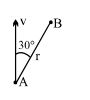
A charge particle $A$ of charge $q = 2\,\, C$ has velocity $v = 100\,\, m/s.$ When it passes through point Aand has velocity in the direction shown. The strength of magnetic field at point $B$ due to this moving charge is.......$\mu T$ $(r = 2\,\, m).$
One microgram of matter converted into energy will give
Carbon $ - 14$ decays with half-life of about $5,800\, years$. In a sample of bone, the ratio of carbon $ - 14$ to carbon $ - 12$ is found to be $\frac{1}{4}$ of what it is in free air. This bone may belong to a period about $x$ centuries ago, where $x$ is nearest to
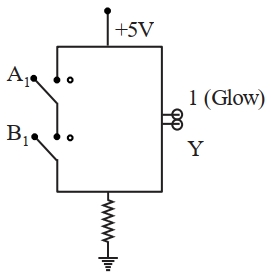
The logic gate equivalent to the given circuit diagram is:
How much water should be filled in a container 21 cm in height, so that it appears half filled when viewed from the top of the container (given that a$\pi \omega$ = 4/3)
Fraunhofer spectrum is a
An electron collides with a free molecule initially in its ground state. The collision leaves the molecule in an excited state that is metastable and does not decay to the ground state by radiation. Let $K$ be the sum of the initial kinetic energies of the electron and the molecule and $p$ be the sum of their initial momenta. Let $K^{\prime}$ and $p ^{\prime}$ represent the same physical quantities after the collision. Then,