MCQ
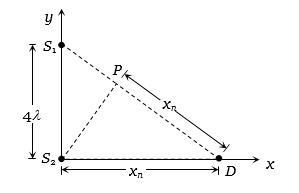
Two coherent sources $S_1$ and $S_2$ are separated by a distance four times the wavelength $\lambda$ of the source. The sources lie along y axis whereas a detector moves along $+ x$ axis. Leaving the origin and far off points the number of points where maxima are observed is
  • A
    $2$
  • $3$
  • C
    $4$
  • D
    $5$

Answer

Correct option: B.
$3$
b
(b) From $\Delta {S_1}{S_2}D,$
${({S_1}D)^2} = {({S_1}{S_2})^2} + {({S_2}D)^2}$
${({S_1}P + PD)^2} = {({S_1}{S_2})^2} + {({S_2}D)^2}$
Here ${S_1}P$ is the path difference $ = n\lambda $ for maximum intensity.
$\therefore {(n\lambda + {x_n})^2} = {(4\lambda )^2} + {({x_n})^2}$
or ${x_n} = \frac{{16{\lambda ^2} - {n^2}{\lambda ^2}}}{{2n\lambda }}$
Then ${x_1} = \frac{{16{\lambda ^2} - {\lambda ^2}}}{{2\lambda }} = 7.5\,\lambda $
${x_2} = \frac{{16{\lambda ^2} - 4{\lambda ^2}}}{{4\lambda }} = 3\lambda $
${x_3} = \frac{{16{\lambda ^2} - 9{\lambda ^2}}}{{6\lambda }} = \frac{7}{6}\lambda $
${x_4} = 0$.
$\therefore $Number of points for maxima becomes $ 3$.

Need a full question paper?

Generate a complete, print-ready paper with questions like this in minutes — across 16+ boards, with answer keys.

Start Generating Free

Similar questions

Heavy water is used as moderator in a nuclear reactor. The function of the moderator is
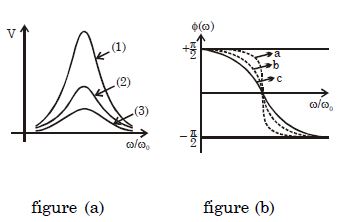
Figure $(a)$  shows plot of voltage across the capacitor as a function of the driving frequency for a sinusoidally driven electromagnetic oscillator $LCR$ circuit. Figure $(b)$ shows phase angle $\phi$ (phase difference between voltage and current) vs $\omega/\omega_0$ graph for same circuit, for three different quality factor graph $1, 2, 3$ of figure $(a)$ and each one can be  matched by one of graphs $a, b, c$ also of figure $(b)$ :-
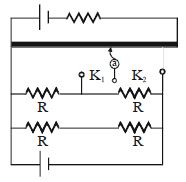
In potentiometer experiment when $K_1$ is closed balance length is $100\,cm$. Then what will be balancing length when $K_2$ is closed ................ $\mathrm{cm}$
The frequency and work function of an incident photon are n and $\phi_{0}$. If $\mathrm{n}_0$ is the threshold frequency then necessary condition for the emission of photo electron is 
A point object in air is in front of the curved surface of a plano-convex lens. The radius of curvature of the curved surface is $30 \;\mathrm{cm}$ and the refractive index of the lens material is $1.5 .$ then the focal length of the lens (in $\mathrm{cm}$ ) is
The work function of a metallic surface is 5.01 eV. The photo-electrons are emitted when light of wavelength 2000Å falls on it. The potential difference applied to stop the fastest photo-electrons is $\left[ h =4.14 \times 10^{-15} eV sec \right]$
The electric field due to a uniformly charged sphere of radius R as a function of the distance from its centre is represented graphically by
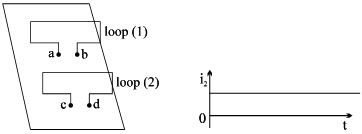
An electric current $i_1$ can flow either direction through loop $(1)$ and induced current $i_2$ in loop $(2)$. Positive $i_1$ is when current is from $'a'$ to $'b'$ in loop $(1)$ and positive $i_2$ is when the current is from $'c'$ to $'d'$ in loop $(2)$ In an experiment, the graph of $i_2$ against time $'t'$ is as shown below Which one $(s)$ of the following graphs could have caused $i_2$ to behave as give above.
In a plane electromagnetic wave, the directions of electric field and magnetic field are represented by $\hat{ k }$ and $2 \hat{ i }-2 \hat{ j },$ respectively What is the unit vector along direction of propagation of the wave.
The radius of a circular ring of wire is $R$ and it carries a current of $I\,ampere$. At its centre a smaller ring of radius $r$ with current $i$ and $N\, turns$ is placed. Assuming that the planes of two rings are perpendicular to each other and the magnetic induction produced at the centre of bigger ring is constant, then the torque acting on smaller ring will be