Two concentric spheres $A$ and $B$ are kept very near to each other. $A$ is negatively charged and $B$ is earthed. The true statement is
$(A)$ Charge on $B$ is zero
$(B)$ Potential at $B$ is zero
$(C)$ Charge is uniformly distributed on $A$
$(D)$ Charge is non uniformly distributed on $A$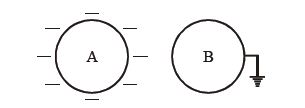
Medium


Download our appand get started for free
Experience the future of education. Simply download our apps or reach out to us for more information. Let's shape the future of learning together!No signup needed.*
Similar Questions
- 1Consider a spherical shell of radius $R$ with a total charge $+ Q$ uniformly spread on its surface (centre of the shell lies at the origin $x=0$ ). Two point charges $+q$ and $-q$ are brought, one after the other from far away and placed at $x=-a / 2$ and $x=+a / 2( < R)$, respectively. Magnitude of the work done in this process isView Solution
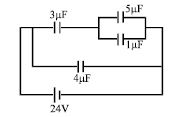
- 2In the circuit shown, the energy stored in $1\,\mu F$ capacitor is.....$\mu J$View Solution
- 3A charge is spread non-uniformly on the surface of a hollow sphere of radius $R$, such that the charge density is given by $\sigma=\sigma_0(1-\sin \theta)$, where $\theta$ is the usual polar angle. The potential at the centre of the sphere isView Solution
- 4In a region, electric field varies as $E = 2x^2 -4$ where $x$ is the distance in metre from origin along $x-$ axis. A positive charge of $1\,\mu C$ is released with minimum velocity from infinity for crossing the origin, thenView Solution
- 5The mean electric energy density between the plates of a charged capacitor is (here $q$= charge on the capacitor and $A$= area of the capacitor plate)View Solution
- 6A capacitor of capacitance $C$ is charged to a potential difference $V_0$. The charging battery is removed and the capacitor is now connected to an uncharged capacitor of unknown capacity, the potential difference across the combination becomes $V$. The unknown capacitance isView Solution
- 7View SolutionA battery is used to charge a parallel plate capacitor till the potential difference between the plates becomes equal to the electromotive force of the battery. The ratio of the energy stored in the capacitor and the work done by the battery will be
- 8In Millikan's experiment, an oil drop having charge $q$ gets stationary on applying a potential difference $V$ in between two plates separated by a distance $d$. The weight of the drop isView Solution
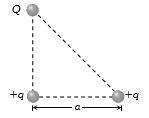
- 9Three charges $Q,\, + q$ and $ + q$ are placed at the vertices of a right-angled isosceles triangle as shown. The net electrostatic energy of the configuration is zero if $Q$ is equal toView Solution
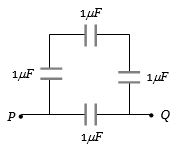
- 10Four capacitors are connected as shown in the equivalent capacitance between the points $P$ and $Q$ is.......$\mu F$View Solution