Question 15 Marks
The electric field in a region is given by $\overrightarrow{\text{E}}=\frac{\text{E}_0\text{x}}{\text{l}}\vec{\text{i}}.$ Find the charge contained inside a cubical volume bounded by the surfaces $x = 0, x = a, y = 0, y = a, z = 0$ and $z = a$. Take $E_0 = 5 \times 10^3Nc^{-1}, l = 2\ cm$ and $a = 1\ cm$.
Answer
View full question & answer→Given:
Electric field strength, $\overrightarrow{\text{E}}=\frac{\text{E}_0\text{x}}{\text{l}}\hat{\text{i}}$ Length $, l = 2\ cm$ Edge of the cube $, a = 1\ cm \ E_0 = 5.0 \times 10^3N/C$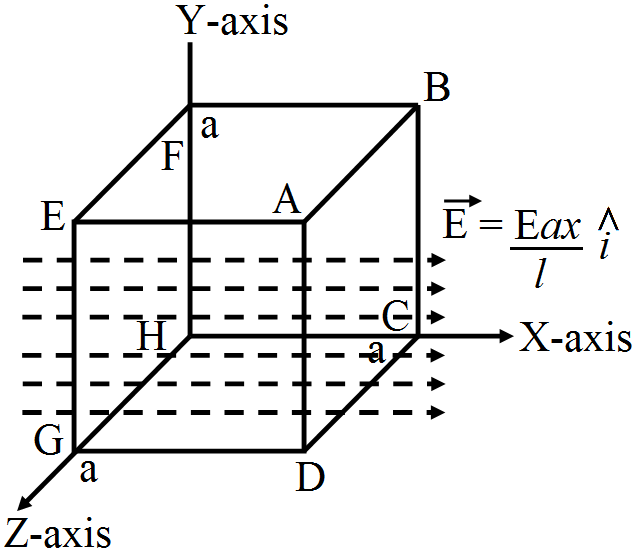
It is observed that the flux passes mainly through the surfaces $\text{ABCD}$ and $\text{EFGH}$.
The surfaces $\text{AEFB}$ and $\text{CHGD}$ are parallel to the electric field.
So, electric flux for these surfaces is zero.
The electric field intensity at the surface $\text{EFGH}$ will be zero.
If the charge is inside the cube, then equal flux will pass through the two parallel surfaces $\text{ABCD}$ and $\text{EFGH}$.
We can calculate flux passing only through one surface.
Thus, $\overrightarrow{\text{E}}=\frac{\text{E}_0\text{x}}{\text{l}}\hat{\text{i}}$ At $\text{EFGH}, x = 0$; thus, the electric field at $\text{EFGH}$ is zero.
At $\text{ABCD}, x = a$; thus, the electric field at $\text{ABCD}$ is $\overrightarrow{\text{E}}=\frac{\text{E}_0\text{a}}{\text{l}}\hat{\text{i}}.$
The net flux through the whole cube is only through the side $\text{ABCD}$ and is given by $\phi=\overrightarrow{\text{E}}.\overrightarrow{\text{A}}=\Big(\frac{\text{E}_0\text{a}}{\text{l}}\hat{\text{i}}\Big).\big(\text{a}\hat{\text{i}}\big)=\frac{\text{E}_0\text{a}^2}{\text{l}}$ Net flux $=\phi=\frac{5\times10^3}{2\times10^{-2}}\times\big(1\times10^{-2}\big)^2\text{Nm}^2/\text{C}$ $=25\text{Nm}^2/\text{C}$
Thus, the net charge, $\text{q}=\epsilon_0\phi$ $\text{q}=8.85\times10^{-12}\times25$ $\text{q}=22.125\times10^{-13}$ $\text{q}=2.2125\times10^{-12}\text{C}$
Electric field strength, $\overrightarrow{\text{E}}=\frac{\text{E}_0\text{x}}{\text{l}}\hat{\text{i}}$ Length $, l = 2\ cm$ Edge of the cube $, a = 1\ cm \ E_0 = 5.0 \times 10^3N/C$
It is observed that the flux passes mainly through the surfaces $\text{ABCD}$ and $\text{EFGH}$.
The surfaces $\text{AEFB}$ and $\text{CHGD}$ are parallel to the electric field.
So, electric flux for these surfaces is zero.
The electric field intensity at the surface $\text{EFGH}$ will be zero.
If the charge is inside the cube, then equal flux will pass through the two parallel surfaces $\text{ABCD}$ and $\text{EFGH}$.
We can calculate flux passing only through one surface.
Thus, $\overrightarrow{\text{E}}=\frac{\text{E}_0\text{x}}{\text{l}}\hat{\text{i}}$ At $\text{EFGH}, x = 0$; thus, the electric field at $\text{EFGH}$ is zero.
At $\text{ABCD}, x = a$; thus, the electric field at $\text{ABCD}$ is $\overrightarrow{\text{E}}=\frac{\text{E}_0\text{a}}{\text{l}}\hat{\text{i}}.$
The net flux through the whole cube is only through the side $\text{ABCD}$ and is given by $\phi=\overrightarrow{\text{E}}.\overrightarrow{\text{A}}=\Big(\frac{\text{E}_0\text{a}}{\text{l}}\hat{\text{i}}\Big).\big(\text{a}\hat{\text{i}}\big)=\frac{\text{E}_0\text{a}^2}{\text{l}}$ Net flux $=\phi=\frac{5\times10^3}{2\times10^{-2}}\times\big(1\times10^{-2}\big)^2\text{Nm}^2/\text{C}$ $=25\text{Nm}^2/\text{C}$
Thus, the net charge, $\text{q}=\epsilon_0\phi$ $\text{q}=8.85\times10^{-12}\times25$ $\text{q}=22.125\times10^{-13}$ $\text{q}=2.2125\times10^{-12}\text{C}$
 Given :
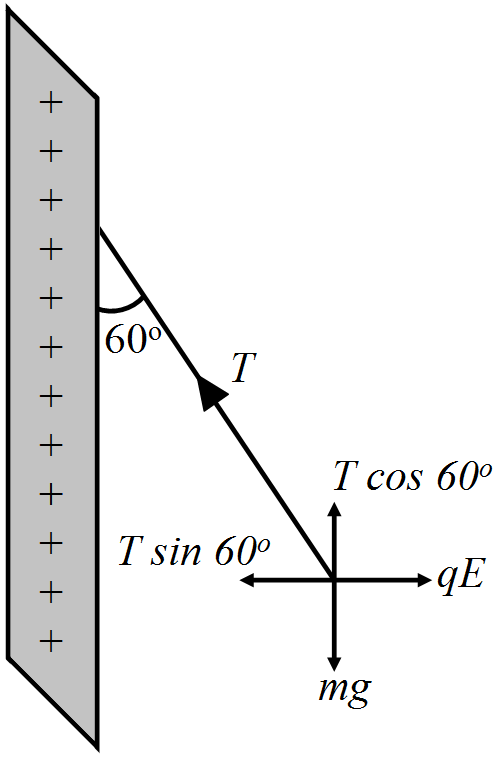
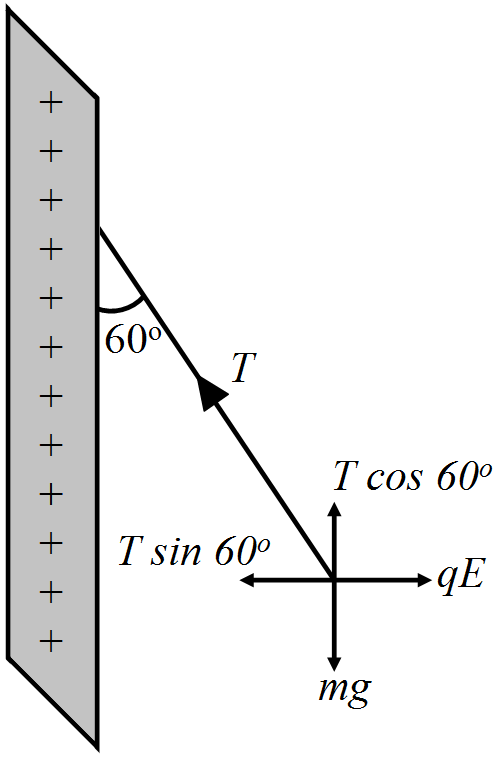 There are two forces acting on the ball. These are: