Question
Two cubes each of volume $27cm^3$ are joined end to end to form a solid. Find the surface area of the resulting cuboid.

Answer

Let the length of each side of each cube $=5 cm$.
Now,
Volume of each cuboid $=27 cm^3$
$\Rightarrow s^3=27$
$\Rightarrow s=3 cm$
When two cubes of each side, 3 cm is joined end to end, then a cuboid is formed.
Now, length of cubiod $( l )=6 cm$,
breadth of cubiod (b) $=3 cm$ and
height of cubiod (h) $=3 cm$
$\therefore \text { Total surface area }=(lb+bh+lh)$
$=2[(6 \times 3)+(3 \times 3)(3 \times 6)]$
$=2[18+9+18]$
$=2 \times 45$
$=90 cm^2$

Need a full question paper?

Generate a complete, print-ready paper with questions like this in minutes — across 16+ boards, with answer keys.
Start Generating Free

Similar questions

A cone, a hemisphere and a cylinder stand on equal bases and have the same height. Show that their volumes are in the ratio 1 : 2 : 3.
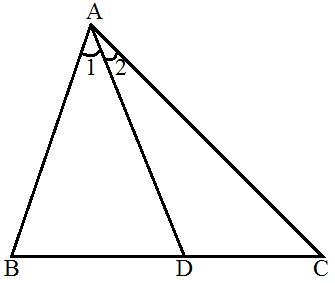
In $\triangle\text{ABC}$ (Fig.), if $\angle1=\angle2,$ prove that $\frac{\text{AB}}{\text{AC}}=\frac{\text{BD}}{\text{DC}}.$
Find the coordinates of a point A, where AB is a diameter of the circle whose centre is (2, -3) and B is (1, 4).
The $13^{th}$​​​​​​​ term of an AP is $4$ times its $3^{rd}​​​​​​​$​​​​​​​ term. If its $5^{th}​​​​​​​$​​​​​​​ term is $16$, find the sum of its first $10$ terms.
Find the sum of all integers between $100$ and $550,$ which are divisible by $9$.
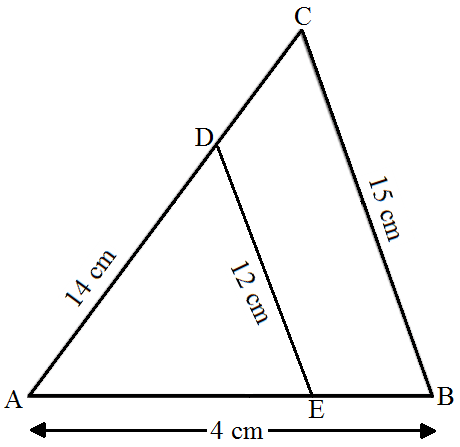
In the given figure, DE || BC. Determine AC and AE.
A right circular cylinder having diameter $12\ cm$ and height $15\ cm$ is full ice-cream. The ice-cream is to be filled in cones of height $12\ cm$ and diameter $6\ cm$ having a hemispherical shape on the top. Find the number of such cones which can be filled with ice-cream.
A solid is composed of a cylinder with hemispherical ends. If the whole length of the solid is $104\ cm$ and the radius of each of the hemispherical ends is $7\ cm$, find the cost of polishing its surface at the rate of $Rs\ 10\ per\ dm^2.$
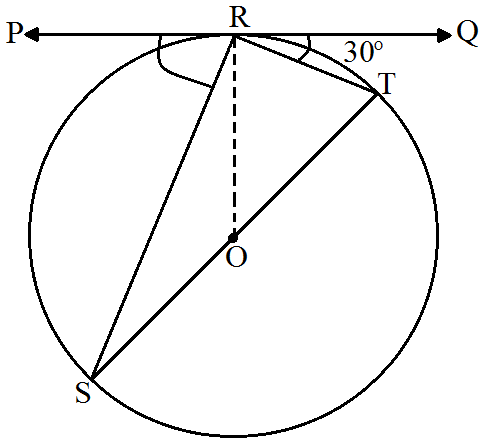
In the given figure, PQ is tangent at a point R of the circle with centre O. If $\angle\text{TRQ}=30^{\circ},$ find m $\angle\text{PRS}$.
If $3\cot\text{A}=4$ check whether $\frac{1+\tan^2\text{A}}{1+\tan^2\text{A}}=\cos^2\text{A}-\sin^2\text{A}$ or not.