MCQ
Two dice are thrown together. The probability that neither they show equal digits nor the sum of their digits is 9 will be:
  • A
    $\frac{13}{15}$
  • $\frac{13}{18}$
  • C
    $\frac{1}{9}$
  • D
    $\frac{8}{9}$

Answer

Correct option: B.
$\frac{13}{18}$
When two dices are thrown, there are (6 × 6) = 36 outcomes.
The set of all these outcomes is the sample space is given by
S = (1, 1), (1, 2), (1, 3), (1, 4), (1, 5), (1, 6)
(2, 1), (2, 2), (2, 3), (2, 4), (2, 5), (2, 6)
(3, 1), (3, 2), (3, 3), (3, 4), (3, 5), (3, 6)
(4, 1), (4, 2), (4, 3), (4, 4), (4, 5), (4, 6)
(5, 1), (5, 2), (5, 3), (5, 4), (5, 5), (5, 6)
(6, 1), (6, 2), (6, 3), (6, 4), (6, 5), (6, 6)
$\therefore\text{n}\text{(S)} = 36$
Let E be the event of getting the digits which are neither equal nor give a total of 9.
Then E' = event of getting either a doublet or a total of 9
Thus, E' = {{1, 1), (2, 2), (3, 3), (4, 4), (5, 5), (6, 6), (3, 6), (4, 5), (5, 4), (6, 3)}
i.e. n(E') = 10
$\text{P(E}')=\frac{\text{n(E}')}{\text{n(E)}}=\frac{10}{36}=\frac{5}{18}$
Hence, required probability P(E) = 1 - P(E')
$=1-\frac{5}{18}=\frac{13}{18}$

Need a full question paper?

Generate a complete, print-ready paper with questions like this in minutes — across 16+ boards, with answer keys.
Start Generating Free

Similar questions

If the tangent to the curve $y^2 = 4x$ at point $(1,2)$ cuts co-ordinate axes at points $A$ and $B$, then area of $\Delta AOB$ is (where $'O'$ is origin)
The three different face diagonals of a cuboid (rectangular parallelopiped) have lengths $39,40,41$. The length of the main diagonal of the cuboid which joins a pair of opposite corners is
If a circle passes through the point $(0, 0), (a, 0), (0, b)$ then its centre is
Let $f (x) = \left[ {\begin{array}{*{20}{c}}  {\tfrac{{{{\tan }^2}\,\,\{ \,x\,\} }}{{{x^2}\,\, - \,\,{{[\,x\,]}^2}}}\,\,\,\,} \\   {1\,\,\,\,\,\,\,\,\,\,\,\,\,\,\,\,\,\,\,\,\,\,\,\,\,\,} \\   {\sqrt {\{ \,x\,\} \,\,\,\cot \,\,\{ \,x\,\} } } \end{array}} \right.\,\,\,\,\,\begin{array}{*{20}{c}}  {for\,\,\,\,\,x\,\, > \,\,0} \\    {for\,\,\,\,\,x\,\, = \,\,0} \\   {for\,\,\,\,\,x\,\, < \,\,0} \end{array}$ where $[ x ]$ is the step up function and $\{ x \}$ is the fractional part function of $x$ , then :
If $\alpha, \beta, \gamma, \delta$ are the roots of the equation $x^{4}+x^{3}+x^{2}+x+1=0$, then $\alpha^{2021}+\beta^{2021}+\gamma^{2021}+\delta^{2021}$ is equal to
The corners of regular tetrahedrons are numbered $1, 2, 3, 4.$ Three tetrahedrons are tossed. The probability that the sum of upward corners will be $5$ is
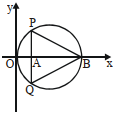
In the circle given below, let $OA =1$ unit, $OB =13$ unit and $PQ \perp OB$. Then, the area of the triangle $PQB$ (in square units) is
For the equation $|x|^2+|x|-6=0$, the sum of the real roots is:
The middle term in the expansion of ${\left( {3x - \frac{{{x^3}}}{6}} \right)^9}$ are :-
If ${^\text{20}}\text{C}_{\text{r}}={^\text{20}}\text{C}_{\text{r-10}}$ is then ${^\text{18}}\text{C}_{\text{r}}$ equal to: