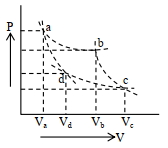
Two different adiabatic paths for the same gas intersect two isothermal curves as shown in$P-V$ diagram. The relation between the ratio $\frac{V_a}{V_d}$ and the ratio $\frac{V_b}{V_c}$ is:
JEE MAIN 2024, Diffcult
Download our app for free and get startedPlay store
For adiabatic process

$\mathrm{TV}^{\gamma-1}=\text { constant }$

$\mathrm{T}_{\mathrm{a}} \cdot \mathrm{V}_{\mathrm{a}}^{\gamma-1}=\mathrm{T}_{\mathrm{d}} \cdot \mathrm{V}_{\mathrm{d}}^{\gamma-1}$

$\left(\frac{\mathrm{V}_{\mathrm{a}}}{\mathrm{V}_{\mathrm{d}}}\right)^{\gamma-1}=\frac{\mathrm{T}_{\mathrm{d}}}{\mathrm{T}_{\mathrm{a}}}$

$\mathrm{T}_{\mathrm{b}} \cdot \mathrm{V}_{\mathrm{b}}^{\gamma-1}=\mathrm{T}_{\mathrm{c}} \cdot \mathrm{V}_{\mathrm{c}}^{\gamma-1}$

$\left(\frac{\mathrm{V}_{\mathrm{b}}}{\mathrm{V}_{\mathrm{c}}}\right)^{\gamma-1}=\frac{\mathrm{T}_{\mathrm{c}}}{\mathrm{T}_{\mathrm{b}}}$

$\mathrm{T}_{\mathrm{b}} \cdot \mathrm{V}_{\mathrm{b}}^{\gamma-1}=\mathrm{T}_{\mathrm{c}} \cdot \mathrm{V}_{\mathrm{c}}^{\gamma-1}$

$\left(\frac{\mathrm{V}_{\mathrm{b}}}{\mathrm{V}_{\mathrm{c}}}\right)^{\gamma-1}=\frac{\mathrm{T}_{\mathrm{c}}}{\mathrm{T}_{\mathrm{b}}}$

$\frac{\mathrm{V}_{\mathrm{a}}}{\mathrm{V}_{\mathrm{d}}}=\frac{\mathrm{V}_{\mathrm{b}}}{\mathrm{V}_{\mathrm{c}}} \quad\left(\begin{array}{r}\because \mathrm{T}_{\mathrm{d}}=\mathrm{T}_{\mathrm{c}} \\ \mathrm{T}_{\mathrm{a}}=\mathrm{T}_{\mathrm{b}}\end{array}\right)$

art

Download our app
and get started for free

Experience the future of education. Simply download our apps or reach out to us for more information. Let's shape the future of learning together!No signup needed.*

Similar Questions

  • 1
    On a $TP$ diagram, two moles of ideal gas perform process $AB$ and $CD$. If the work done by the gas in the process $AB$ is two times the work done in the process $CD$ then what is the value of $T_1/T_2$?
    View Solution
  • 2
    Initial pressure and volume of a gas are $P$ and $V$ respectively. First it is expanded isothermally to volume $4V$ and then compressed adiabatically to volume $V$ . The final pressure of gas will be (given $\gamma = 3/2$ ) 
    View Solution
  • 3
    Out of the following which quantity does not depend on path
    View Solution
  • 4
    Which is incorrect
    View Solution
  • 5
    Consider the efficiency of Carnot's engine is given by $\eta=\frac{\alpha \beta}{\sin \theta} \log _{e} \frac{\beta x}{k T}$, where $\alpha$ and $\beta$ are constants. If $T$ is temperature, $k$ is Boltzman constant, $\theta$ is angular displacement and $x$ has the dimensions of length. Then, choose the incorrect option.
    View Solution
  • 6
    An ideal gas is expanding such that $\mathrm{PT}^2=$ constant. The coefficient of volume expansion of the gas is
    View Solution
  • 7
    In a thermodynamic system working substance is ideal gas, its internal energy is in the form of
    View Solution
  • 8
    When heat is given to a gas in an isothermal change, the result will be
    View Solution
  • 9
    An ideal gas expands isothermally from a volume ${V_1}$ to ${V_2}$ and then compressed to original volume ${V_1}$adiabatically. Initial pressure is ${P_1}$ and final pressure is ${P_3}$. The total work done is $W$. Then
    View Solution
  • 10
    One mole of an ideal gas is taken through an adiabatic process where the temperature rises from $27^{\circ} {C}$ to $37^{\circ} {C}$. If the ideal gas is composed of polyatomic molecule that has $4$ vibrational modes which of the following is true?
    View Solution