MCQ
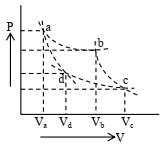
Two different adiabatic paths for the same gas intersect two isothermal curves as shown in$P-V$ diagram. The relation between the ratio $\frac{V_a}{V_d}$ and the ratio $\frac{V_b}{V_c}$ is:
  • A
    $\frac{V_a}{V_d}=\left(\frac{V_b}{V_c}\right)^{-1}$
  • B
    $\frac{V_a}{V_d} \neq \frac{V_b}{V_c}$
  • $\frac{V_a}{V_d}=\frac{V_b}{V_c}$
  • D
    $\frac{V_a}{V_d}=\left(\frac{V_b}{V_c}\right)^2$

Answer

Correct option: C.
$\frac{V_a}{V_d}=\frac{V_b}{V_c}$
c
For adiabatic process

$\mathrm{TV}^{\gamma-1}=\text { constant }$

$\mathrm{T}_{\mathrm{a}} \cdot \mathrm{V}_{\mathrm{a}}^{\gamma-1}=\mathrm{T}_{\mathrm{d}} \cdot \mathrm{V}_{\mathrm{d}}^{\gamma-1}$

$\left(\frac{\mathrm{V}_{\mathrm{a}}}{\mathrm{V}_{\mathrm{d}}}\right)^{\gamma-1}=\frac{\mathrm{T}_{\mathrm{d}}}{\mathrm{T}_{\mathrm{a}}}$

$\mathrm{T}_{\mathrm{b}} \cdot \mathrm{V}_{\mathrm{b}}^{\gamma-1}=\mathrm{T}_{\mathrm{c}} \cdot \mathrm{V}_{\mathrm{c}}^{\gamma-1}$

$\left(\frac{\mathrm{V}_{\mathrm{b}}}{\mathrm{V}_{\mathrm{c}}}\right)^{\gamma-1}=\frac{\mathrm{T}_{\mathrm{c}}}{\mathrm{T}_{\mathrm{b}}}$

$\mathrm{T}_{\mathrm{b}} \cdot \mathrm{V}_{\mathrm{b}}^{\gamma-1}=\mathrm{T}_{\mathrm{c}} \cdot \mathrm{V}_{\mathrm{c}}^{\gamma-1}$

$\left(\frac{\mathrm{V}_{\mathrm{b}}}{\mathrm{V}_{\mathrm{c}}}\right)^{\gamma-1}=\frac{\mathrm{T}_{\mathrm{c}}}{\mathrm{T}_{\mathrm{b}}}$

$\frac{\mathrm{V}_{\mathrm{a}}}{\mathrm{V}_{\mathrm{d}}}=\frac{\mathrm{V}_{\mathrm{b}}}{\mathrm{V}_{\mathrm{c}}} \quad\left(\begin{array}{r}\because \mathrm{T}_{\mathrm{d}}=\mathrm{T}_{\mathrm{c}} \\ \mathrm{T}_{\mathrm{a}}=\mathrm{T}_{\mathrm{b}}\end{array}\right)$
Need a full question paper?

Generate a complete, print-ready paper with questions like this in minutes — across 16+ boards, with answer keys.

Start Generating Free

Similar questions

A simple pendulum of mass $200\, gm$ and length $100\, cm$ is moved aside till the string makes an angle of $60^o$ with the vertical. The kinetic and potential energies of the bob, when the string is inclined at $30^o$ to the vertical, are
A person sitting firmly over a rotating stool has his arms stretched. If he folds his arms, his angular momentum about the axis of rotation:
The approximate depth of an ocean is $2700\,\, m.$ The compressibility of water is $45.4 \times 10^{-11} Pa^{-1}$ and density of water is $10^3 \,kg/m^3 $. What fractional compression of water will be obtained at the bottom of the ocean?
A block of mass $m$ is hung vertically from an elastic thread of force constant $\frac{{2mg}}{a}$ .Initially the thread was at its natural length and the block is allowed to fall freely. The work done on block by earth when it passes through the equilibrium position will be
For a mole of solid the total energy is:
The acceleration of a body in a non-uniform circular motion is $5\, ms^{-2}$. Which one of the following is correct?
The ratio of the distances travelled by a freely falling body in the $1^{\text {st }}, 2^{\text {nd }}, 3^{\text {rd }}$ and $4^{\text {th }}$ second :
A body of mass $40 \,gm$ is moving with a constant velocity of $2\, cm/sec$ on a horizontal frictionless table. The force on the table is  ....... $dyne$
At the surface of a certain planet, acceleration due to gravity is one-quarter of that on earth. If a brass ball is transported to this planet, then which one of the following statements is not correct
The energy which an ${e^ - }$ acquires when accelerated through a potential difference of $1 \,volt$ is called