Two different liquids are flowing in two tubes of equal radius. The ratio of coefficients of viscosity of liquids is $52:49$ and the ratio of their densities is $13:1$, then the ratio of their critical velocities will be
Medium


Download our appand get started for free
Experience the future of education. Simply download our apps or reach out to us for more information. Let's shape the future of learning together!No signup needed.*
Similar Questions
- 1Three identical vessels are filled to the same height with three different liquids $A, B$ and $C$ $({\rho _A} > {\rho _B} > {\rho _C})$. The pressure at the base will beView Solution
- 2Small water droplets of radius $0.01 \mathrm{~mm}$ are formed in the upper atmosphere and falling with a terminal velocity of $10 \mathrm{~cm} / \mathrm{s}$. Due to condensation, if $8 \mathrm{such}$ droplets are coalesced and formed a larger drop, the new terminal velocity will be ........... $\mathrm{cm} / \mathrm{s}$.View Solution
- 3A table tennis ball has radius $(3 / 2) \times 10^{-2} m$ and mass $(22 / 7) \times 10^{-3} kg$. It is slowly pushed down into a swimming pool to a depth of $d=0.7 m$ below the water surface and then released from rest. It emerges from the water surface at speed $v$, without getting wet, and rises up to a height $H$. Which of the following option(s) is (are) correct?View Solution
[Given: $\pi=22 / 7, g=10 ms ^{-2}$, density of water $=1 \times 10^3 kg m ^{-3}$, viscosity of water $=1 \times 10^{-3} Pa$-s.]
$(A)$ The work done in pushing the ball to the depth $d$ is $0.077 J$.
$(B)$ If we neglect the viscous force in water, then the speed $v=7 m / s$.
$(C)$ If we neglect the viscous force in water, then the height $H=1.4 m$.
$(D)$ The ratio of the magnitudes of the net force excluding the viscous force to the maximum viscous force in water is $500 / 9$.
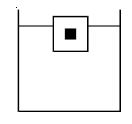
- 4View SolutionThere is a metal cube inside a block of ice which is floating on the surface of water. The ice melts completely and metal falls in the water. Water level in the container
- 5A tank is filled with water of density $1\,g$ per $cm^3$ and oil of density $0.9\,g$ per $cm^3$ . The height of water layer is $100\,cm$ and of the oil layer is $400\,cm.$ If $g = 980\,cm/sec^2,$ then the velocity of efflux from an opening in the bottom of the tank isView Solution
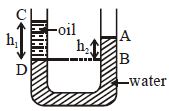
- 6In a $U-$ tube experiment, a column $AB$ of water is balanced by a column $‘CD’$ of oil, as shown in the figure. Then the relative density of oil isView Solution
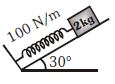
- 7A small metal sphere of radius $a$ is falling with a velocity $v$ through a vertical column of a viscous liquid. If the coefficient of viscosity of the liquid is $\eta $ , then the sphere encounters an opposing force ofView Solution
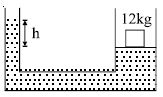
- 8The area of cross-section of the wider tube shown in figure is $800$ $cm^2$. If a mass of $12$ $ kg $ is placed on the massless piston, the difference in heights $h$ in the level of water in the two tubes is ........ $cm$View Solution
- 9Two capillary tubes of the same length but different radii $r_1 $ and $r_2$ are fitted in parallel to the bottom of a vessel. The pressure head is $ P. $ What should be the radius of a single tube that can replace the two tubes so that the rate of flow is same as beforeView Solution
- 10In Millikan's oil drop experiment, what is viscous force acting on an uncharged drop of radius $2.0 \times 10^{-5}\, {m}$ and density $1.2 \times 10^{3} \,{kgm}^{-3}$ ? Take viscosity of liquid $=1.8 \times 10^{-5}\, {Nsm}^{-2} .$ (Neglect buoyancy due to air).View Solution