MCQ
Two different loops are concentric and lie in the same plane. The current in the outer loop is clockwise and increasing with time. The induced current in the inner loop then, is
  • A
    Clockwise
  • B
    Zero
  • Counter clockwise
  • D
    In a direction that depends on the ratio of the loop radii
Answer

Correct option: C.
Counter clockwise
The induced current will be in such a direction so that it opposes the change due to which it is produced.

Need a full question paper?

Generate a complete, print-ready paper with questions like this in minutes — across 16+ boards, with answer keys.

Start Generating Free

Similar questions

If the length of simple pendulum is increased by $300 \%$, then the time period will be increased by
The weight of an object in the coal mine, sea level, at the top of the mountain are $W_1, W_2$ and $W_3$ respectively, then
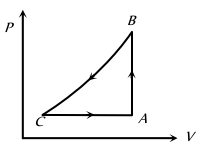
A sample of an ideal gas is taken through a cycle a shown in figure. It absorbs 50 / of energy during the process $A B$, no heat during $B C$, rejects $70 \mathrm{~J}$ during $C A .40 \mathrm{~J}$ of work is done on the gas during $B C$. Internal energy of gas at $A$ is 1500 /, the internal energy at $C$ would be
Image
If there had been one eye of the man, then
An imaginary line joining the optical centre of the eye lens and the yellow point is called as
A circular coil having $N\,turns$ and radius $r$ carries a current. It is held in the $XZ$ plane in a magnetic field $B\hat i$ . The torque on the coil due to the magnetic field is
If $v$ is the velocity of sound in moist air, $v$ is the velocity of sound in dry air, under identical conditions of pressure and temperature
A thermodynamic system goes from states (i) $P_1, V$ to $2 P_1, V$ (ii) $P, V$ to $P, 2 V$. Then work done in the two cases is
A particle at the end of a spring executes simple harmonic motion with a period $t_1$, while the corresponding period for another spring is $t_2$. If the period of oscillation with the two springs in series is $T$, then
In Milikan's experiment, an oil drop having charge $q$ gets stationary on applying a potential difference $V$ in between two plates separated by a distance ' $d$. The weight of the drop is