Two electric bulbs whose resistance are in the ratio of $1: 2$, are connected in parallel to a constant voltage source. The power dissipated in them has the ratio
Easy
Download our app for free and get started
(a)
$P=\frac{V^2}{R}$
$P \propto \frac{1}{R}$
$\frac{P_1}{P_2}=\frac{R_2}{R_1}=\frac{2}{1}$

Download our appand get started for free
Experience the future of education. Simply download our apps or reach out to us for more information. Let's shape the future of learning together!No signup needed.*
Similar Questions
- 1A $220\, volt$ and $800\, watt$ electric kettle and three $220\, volt$ and $100\, watt$ bulbs are connected in parallel. On connecting this combination with $220\, volt$ electric supply, the total current will be ................ $ampere$View Solution
- 2A cell of constant $e.m.f.$ first connected to a resistance ${R_1}$ and then connected to a resistance ${R_2}$. If power delivered in both cases is then the internal resistance of the cell isView Solution
- 3It takes $12$ minutes to boil $1$ litre of water in an electric kettle. Due to some defect it becomes necessary to remove $20 \%$ turns of heating coil of the kettle. After repair, how much time will it take to boil $1$ litre of water.View Solution
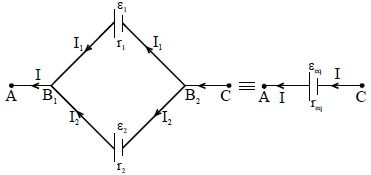
- 4Consider a parallel combination of the cellsshown in the figure.The potential difference in between $B_1$ and $B_2$ isView Solution
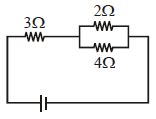
- 5If power in $3\,\Omega $ is $27\,W$ then what is the power in $2\,\Omega $ ................. $W$View Solution
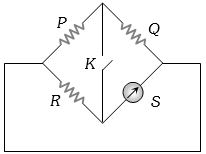
- 6In the following Wheatstone bridge $P/Q = R/S$. If key $K$ is closed, then the galvanometer will show deflectionView Solution
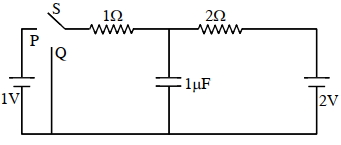
- 7In the circuit shown below, the switch $S$ is connected to position $P$ for a long time so that the charge on the capacitor becomes $q _1 \mu C$. Then $S$ is switched to position $Q$. After a long time, the charge on the capacitor is $q _2 \mu C$.View Solution
($1$) The magnitude of $q_1$ is
($2$) The magnitude of $q _2$ is
Give the answer of question ($1$) and ($2$)
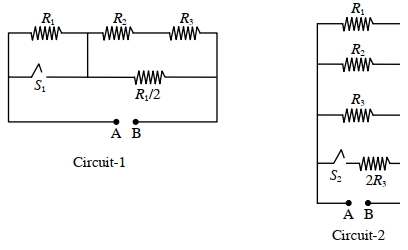
- 8In Circuit-$1$ and Circuit- $2$ shown in the figures, $R_1=1 \Omega, R_2=2 \Omega$ and $R_3=3 \Omega$. $P_1$ and $P_2$ are the power dissipations in Circuit-$1$ and Circuit-$2$ when the switches $S_1$ and $S_2$ are in open conditions, respectively. $Q_1$ and $Q_2$ are the power dissipations in Circuit-$1$ and Circuit-$2$ when the switches $S_1$ and $S_2$ are in closed conditions, respectively.View Solution
Which of the following statement($s$) is(are) correct?
$(A)$ When a voltage source of $6 V$ is connected across $A$ and $B$ in both circuits, $P_1$
$(B)$ When a constant current source of $2 Amp$ is connected across $A$ and $B$ in both circuits, $P_1>P_2$.
$(C)$ When a voltage source of $6 V$ is connected across $A$ and $B$ in Circuit-$1$, $Q_1>P_1$.
$(D)$ When a constant current source of $2 Amp$ is connected across $A$ and $B$ in both circuits, $Q_2$
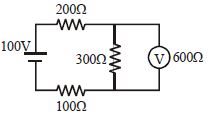
- 9The reading of voltmeter is :- .............. $V$View Solution
- 10The potential difference in open circuit for a cell is $2.2\, volts$. When a $4\, ohm$ resistor is connected between its two electrodes the potential difference becomes $2\, volts$. The internal resistance of the cell will be .............. $ohm$View Solution