MCQ
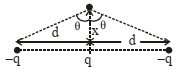
Two electrons each are fixed at a distance $'2d'$. A third charge proton placed at the midpoint is displaced slightly by a distance $x ( x << d )$ perpendicular to the line joining the two fixed charges. Proton will execute simple harmonic motion having angular frequency : $( m =$ mass of charged particle)
  • A
    $\left(\frac{2 q^{2}}{\pi \varepsilon_{0} m d^{3}}\right)^{\frac{1}{2}}$
  • B
    $\left(\frac{\pi \varepsilon_{0} md ^{3}}{2 q ^{2}}\right)^{\frac{1}{2}}$
  • $\left(\frac{ q ^{2}}{2 \pi \varepsilon_{0} md ^{3}}\right)^{\frac{1}{2}}$
  • D
    $\left(\frac{2 \pi \varepsilon_{0} md ^{3}}{ q ^{2}}\right)^{\frac{1}{2}}$
Answer

Correct option: C.
$\left(\frac{ q ^{2}}{2 \pi \varepsilon_{0} md ^{3}}\right)^{\frac{1}{2}}$
c
From the given condition, we have

$F _{\text {net}}=-\left[2 F _{ q / q } \cos \theta\right]$

$F _{\text {net}}=-2 \cdot \frac{1}{4 \pi \varepsilon_{0}} \cdot \frac{ q ^{2}}{\left(\sqrt{ d ^{2}+ x ^{2}}\right)^{2}} \cdot \frac{ x }{\sqrt{ d ^{2}+ x ^{2}}}$

$=-\frac{q^{2}}{2 \pi \varepsilon_{0}} \frac{x}{\left(d^{2}+x^{2}\right)^{3 / 2}}$

For $x ( x << d )$

$F_{\text {net }}=-\frac{q^{2}}{2 \pi \varepsilon_{0} d^{3}} x$

$\therefore a =-\frac{ q ^{2}}{2 \pi \varepsilon_{0} \cdot md ^{3}} x$

Comparing with equation of $SHM \left( a =-\omega^{2} x \right)$

$\therefore \omega=\sqrt{\frac{ q ^{2}}{2 \pi \varepsilon_{0} md ^{3}}}$

Need a full question paper?

Generate a complete, print-ready paper with questions like this in minutes — across 16+ boards, with answer keys.

Start Generating Free

Similar questions

Resistance are connected in a meter bridge circuit as shown in the figure. The balancing length $l_{1}$ is $40\,cm$. Now an unknown resistance $x$ is connected in series with $P$ and new balancing length is found to be $80\,cm$ measured from the same end. Then the value of $x$ will be $.......\Omega$
The narrowest hysterisis loop is for:
Two negative charges are kept at a certain distance in the air medium. What will happen if a dielectric slab is inserted between them?
A luminous object is placed at a distance of $30 \,cm$ from the convex lens of focal length $20 \,cm$. On the other side of the lens, at what distance from the lens a convex mirror of radius of curvature $10\, cm$ be placed in order to have an upright image of the object coincident with it.....$cm$
The current through a wire depends on time as $i = (2+3t)\, mA$. The charge crossing through a section of the wire in $1\, min$ is .............. $\mathrm{C}$
Green light of wavelength $5460 \mathring A$ is incident on an air-glass interface. If the refractive index of glass is $1.5$, the wave length of light in glass would be ........ $\mathring A$

$\left( c =3 \times 10^8 ms ^{-1}\right)$

An electron is accelerated through a potential difference of $1000$ volts. Its velocity is nearly
Abeam of unpolarised light of intensity $I_0$ is passed through a polaroid $A$ and then through another polaroid $B$ which is oriented so that its principal plane makes an angle of $45^{\circ}$ relative to that of $A$. The intensity of emergent light is :
A solenoid of $1200$ turns is wound uniformly in a single layer on a glass tube $2\,m$ long and $0.2\,m$ in diameter. The magnetic intensity at the center of the solenoid when a current of $2\,A$ flows through it is:
An amplitude modulated signal is given by $V(t) = \,10\,[1 + 0.6\,\cos \,(2.2 \times {10^4}\,t)\,\sin \,(5.5\, \times \,{10^5}\,t)]$ Here $t$ is in seconds. The seconds The sideband frequencies (in $kHz$ ) are [Given $\pi = 22/7$ ]