- AExecute simple harmonic motion about the origin
- BMove to the origin and remain at rest
- CMove to infinity
- ✓Execute oscillatory but not simple harmonic motion
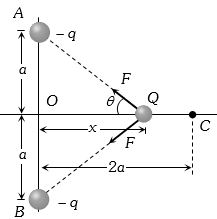
${F_{net}} \Rightarrow 2F\cos \theta $ $ = 2\frac{1}{{4\pi {\varepsilon _0}}}\frac{{ - qQ}}{{({a^2} + {x^2})}}$ $ \times \frac{{ x}}{{({a^2} + {x^2})^{1/2}}}$
i.e., ${F_{net}} = - \frac{1}{{4\pi {\varepsilon _0}}}.\frac{{2qQx}}{{{{({a^2} + {x^2})}^{3/2}}}}$
As the restoring force Fnet is not linear, motion will be oscillatory (with amplitude $2a$) but not simple harmonic.
Generate a complete, print-ready paper with questions like this in minutes — across 16+ boards, with answer keys.
$(a)$ The size of the antenna should be comparable to signal wavelength which is unreal solution for a signal of longer wavelength.
$(b)$ Effective power radiated by a long wavelength baseband signal would be high.
$(c)$ We want to avoid mixing up signals transmitted by different transmitter simultaneously.
$(d)$ Low frequency signal can be sent to long distances by superimposing with a high frequency wave as well.
Therefore, the most suitable options will be