MCQ
Two forces of 10 N each are acting at an angle $\theta^{\circ}$ at a point. Their resultant force is 10 N . The value of $\theta$ will be.
  • A
    $0^{\circ}$
  • B
    $60^{\circ}$
  • $120^{\circ}$
  • D
    $180^{\circ}$

Answer

Correct option: C.
$120^{\circ}$
(C) Resultant force :
$\begin{aligned} F ^2 & = F _1^2+ F _2^2+2 F_1 F_2 \cos \theta \\ (10)^2 & =(10)^2+(10)^2+2 \times 10 \times 10 \times \cos \theta \\ 100 & =100+100+200 \cos \theta \\ -100 & =200 \cos \theta \\ \cos \theta & =-\frac{100}{200}=-\frac{1}{2}=\cos 120^{\circ}
\\ ∴\theta  =120^{\circ}\end{aligned}$
Hence, option (C) is correct.

Need a full question paper?

Generate a complete, print-ready paper with questions like this in minutes — across 16+ boards, with answer keys.
Start Generating Free

Similar questions

If the $rms$ speed of oxygen molecules at $0^{\circ} {C}$ is $160\; {m} / {s}$, find the rms speed of hydrogen molecules at $0^{\circ} {C}$. (In ${m}/{s}$)
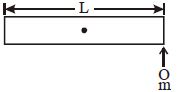
A stick of length $L$ and mass $M$ lies on a frictionless horizontal surface on which it is free to move in any ways. A ball of mass $m$ moving with speed $v$ collides elastically with the stick as shown in the figure. If after the collision the ball comes to rest, then what should be the mass of the ball ?
The change in the value of acceleration of earth towards sun, when the moon comes from the position of solar eclipse to the position on the other side of earth in line with sun is: (mass of the moon $= 7.36 \times 10^{22}\,kg,$ radius of the moon's orbit $= 3 .8 \times 10^8\,m$ ).
A football player throws a ball with a velocity of $50$ metre/sec at an angle $30 $ degrees from the horizontal. The ball remains in the air for  ...... $\sec$ $(g = 10\,m/{s^2})$
A weightless thread can bear a tension upto $3.7\,kg-wt$ . A stone of mass $500\,g$ is tied to it and revolved in a circular path of radius $4\,m$ in a vertical plane. If $g = 10\,ms^{-2}$, then the maximum angular velocity of the stone will be ......... $rad\,s^{-1}$
If $Z=\frac{A^{2} B^{3}}{C^{4}}$, then the relative error in $Z$ will be
On the $x-$axis and a dsitance $x$ from the origin, the gravitational field due to a mass distribution is given by $\frac{A x}{\left(x^{2}+a^{2}\right)^{3 / 2}}$ in the $x-$direction. The magnitude of gravitational potential on the $x-$axis at a distance $x,$ taking its value to be zero at infinity, is
Two vectors having equal magnitudes of $x\, units$ acting at an angle of $45^o$ have resultant $\sqrt {\left( {2 + \sqrt 2 } \right)} $ $units$. The value of $x$ is
Three liquids of densities $\rho _1,\rho _2$ and $\rho _3$ (with $\rho _1 > \rho _2 > \rho_3),$ having the same value of surface tension $T,$ rise to the same height in three identical capillaries. The angles of contact $\theta_1 \,,\theta_2$ and $\theta_3$ obey  
Which of the diagrams in correctly shows the change in kinetic energy of an iron sphere falling freely in a lake having sufficient depth to impart it a terminal velocity?