MCQ
Two forces of $12 \,N$ and $8 \,N$ act upon a body. The resultant force on the body has maximum value of........$N$
  • A
    $4$
  • B
    $0$
  • $20$
  • D
    $8 $

Answer

Correct option: C.
$20$
c
(c) ${R_{\max }} = A + B$ when $\theta = 0^\circ $

$\therefore $ ${R_{\max }} = 12 + 8 = 20\,N$

Need a full question paper?

Generate a complete, print-ready paper with questions like this in minutes — across 16+ boards, with answer keys.
Start Generating Free

Similar questions

A cylindrical vessel partially filled with water is rotated about its vertical central axis. It’s surface will
The speed of a satellite in a circular orbit of radius $R_0$ around the earth is $v_0$. Another satellite is in an elliptic orbit around the earth. If the minimum and maximum speeds of the second satellite are $\alpha v_0$ and $\beta v_0$ respectively, then its time period is
Two moles of an ideal monoatomic gas at ${27^o}C$ occupies a volume of $V.$ If the gas is expanded adiabatically to the volume $2V,$ then the work done by the gas will be ....... $J$ $[\gamma = 5/3,\,R = 8.31J/mol\,K]$
The trajectory of a projectile near the surface of the earth is given as$ y = 2x -9x^2$. If it were launched at an angle $\theta_0$ with speed $v_0$ then $(g = 10\, ms^{-2}$)
The maximum wavelength of radiations emitted at $900\,K$ is $4\mu m$. What will be the maximum wavelength of radiations emitted at $1200 \,K$ ......... $\mu m$
The kinetic energy of translation of $20\, gm$ of oxygen at $47°C$ is (molecular wt. of oxygen is $32 \,gm/mol$ and $R = 8.3\, J/mol/K)$
Liquids have:
An electron is moving in a circle of radius $2 \,m$ with speed $4 \,m / s$ Find the acceleration of the electron. (in $m / s ^{2}$)
In an experiment the angles are required to be measured using an instrument, $29$ divisions of the main scale exactly coincide with the $30$ divisions of the vernier scale. If the smallest division of the main scale is half- a degree $(= 0.5^o  )$, then the least count of the instrument is
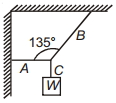
A block of weight $W$ is supported by three strings as shown in figure. Which of the following relations is true for tension in the strings? (Here $T_1, T_2$ and $T_3$ are the tension in the strings $A, B$ and $C$ respectively)