MCQ
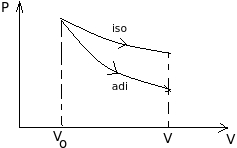
Two gases have the same initial pressure, volume and temperatue. They expand to the same final volume, one adiabatically and the other isothermally
  • A
    The final temperature is greater for the isothermal process
  • B
    The final pressure is greater for the isothermal process
  • C
    The work done by the gas is greater for the isothermal process
  • All of the above 

Answer

Correct option: D.
All of the above 
d
Work done is equal to area under the P-V graph, thus work done by gas is greater for isothermal process.

For isothermal process: $T_{2}=T_{o}$

For adibatic process: $T_{o}\left(V_{o}\right)^{\gamma-1}=T(V)^{\gamma-1}$

As $V>V_{o} \Longrightarrow T

Thus final temp. is greater for isothermal process.

For isothermal process: $P_{o} V_{o}=P_{i} V \quad \Longrightarrow P_{i}=P_{o} \frac{V_{o}}{V}$

For adibatic process: $P_{o}\left(V_{o}\right)^{\gamma}=P_{a}(V)^{\gamma}$

$\Longrightarrow P_{a}=P_{o}\left(\frac{V_{o}}{V}\right)^{\gamma}$

As $\gamma>1 \quad$ (always) $\Longrightarrow P_{i}>P_{a}$

Need a full question paper?

Generate a complete, print-ready paper with questions like this in minutes — across 16+ boards, with answer keys.

Start Generating Free

Similar questions

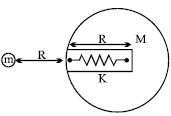
A small ball of mass $‘m’$ is released at a height $‘R’$ above the earth surface, as shown in the figure above. If the maximum depth of the ball to which it goes is $R/2$ inside the earth through a narrow grove before coming to rest momentarily. The grove, contain an ideal spring of spring constant $K$ and natural length $R,$ find the value of $K$ if $R$ is radius of earth and $M$ mass of earth
The radius of gyration of body depends upon
Magnetic effect of current is discovered by:
The apparent frequency of a sound wave as heard by an observer is $10\%$ more than the actual frequency. If the velocity of sound in air is $330\,m/sec$ , then

$(i)$ The source may be moving towards the observer with a velocity of $30\,ms^{-1}$

$(ii)$ The source may be moving towards the observer with a velocity of $33\,ms^{-1}$

$(iii)$ The observer may be moving towards the source with a velocity of $30\,ms^{-1}$

$(iv)$ The observer may be moving towards the source with a velocity of $33\,ms^{-1}$

If opened door of a refrigerator in working condition kept in an insulated room:
To mop-clean a floor, a cleaning machine presses a circular mop of radius $R$ vertically down with a total force $F$ and rotates it with a constant angular speed about its axis. If the force $F$ is distributed uniformly over the mop and the floor is $\mu $, the torque, applied by the machine on the mop is
$N$ molecules each of mass $m$ of gas $A$ and $2N$ molecules each of mass $2m$ of gas $B$ are contained in the same vessel at temperature $T.$ The mean square of the velocity of molecules of gas $B$ is ${v^2}$ and the mean square of $x$ component of the velocity of molecules of gas $A$ is ${w^2}$. The ratio $\frac{{{w^2}}}{{{v^2}}}$ is
A system $S$ receives heat continuously from an electrical heater of power $10W$. The temperature of S becomes constant at $50^o C$ when the surrounding temperature is $20^o C$. After the heater is switched off, $S$ cools from $35.1^o C$ to $34.9^o C$ in $1$ minute. The heat capacity of $S$ is........ $ J/^oC$
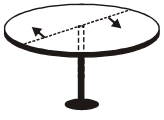
A horizontal circular platform of radius $0.5 \ m$ and mass $0.45 \ kg$ is free to rotate about its axis. Two massless spring toy-guns, each carrying a steel ball of mass $0.05 \ kg$ are attached to the platfrom at a distance $0.25 \ m$ from the centre on its either sides along its diameter (see figure). Each gun simultaneously fires the balls horizontally and perpendicular to the diameter in opposite directions. After leaving the platfrom, the balls have horizontal speed of $9 \ ms ^{-1}$ with respect to the ground. The rotational speed of the platfrom in rad ${ }^{-1}$ after the balls leave the platform is
Which of the following is not a dimensional constant?