MCQ
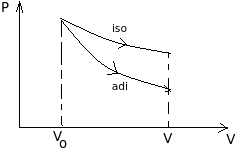
Two gases have the same initial pressure, volume and temperatue. They expand to the same final volume, one adiabatically and the other isothermally
  • A
    The final temperature is greater for the isothermal process
  • B
    The final pressure is greater for the isothermal process
  • C
    The work done by the gas is greater for the isothermal process
  • All of the above 

Answer

Correct option: D.
All of the above 
d
Work done is equal to area under the P-V graph, thus work done by gas is greater for isothermal process.

For isothermal process: $T_{2}=T_{o}$

For adibatic process: $T_{o}\left(V_{o}\right)^{\gamma-1}=T(V)^{\gamma-1}$

As $V>V_{o} \Longrightarrow T

Thus final temp. is greater for isothermal process.

For isothermal process: $P_{o} V_{o}=P_{i} V \quad \Longrightarrow P_{i}=P_{o} \frac{V_{o}}{V}$

For adibatic process: $P_{o}\left(V_{o}\right)^{\gamma}=P_{a}(V)^{\gamma}$

$\Longrightarrow P_{a}=P_{o}\left(\frac{V_{o}}{V}\right)^{\gamma}$

As $\gamma>1 \quad$ (always) $\Longrightarrow P_{i}>P_{a}$

Need a full question paper?

Generate a complete, print-ready paper with questions like this in minutes — across 16+ boards, with answer keys.

Start Generating Free

Similar questions

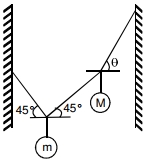
Two masses $m$ and $M$ are attached to the strings as shown in the figure. If the system is in equilibrium, then
An object flying in alr with velocity $(20 \hat{\mathrm{i}}+25 \hat{\mathrm{j}}-12 \hat{\mathrm{k}})$ suddenly breaks in two pleces whose masses are in the ratio $1: 5 .$ The smaller mass flies off with a velocity $(100 \hat{\mathrm{i}}+35 \hat{\mathrm{j}}+8 \hat{\mathrm{k}}) .$ The velocity of larger piece will be
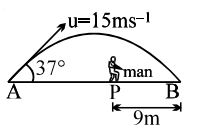
A ball is hit by a batsman at an angle of $37^o$ as shown in figure. The man standing at $P$ should run at what minimum velocity so that he catches the ball before it strikes the ground. Assume that height of man is negligible in comparison to maximum height of projectile.  ........ $ms^{-1}$
$10\, gm$ of ice at $0°C$ is mixed with $100 \,gm $ of water at $50°C.$ What is the resultant temperature of mixture........ $^oC$
The density of a newly discovered planet is twice that of earth. The acceleration due to gravity at the surface of the planet is equal to that at the surface of the earth. If the radius of the earth is surface of the earth. If the radius of the earth is R, the radius of the planet would be:
If one mole of the polyatomic gas is having two vibrational modes and $\beta$ is the ratio of molar specific heats for polyatomic gas $\left(\beta=\frac{ C _{ P }}{ C _{ v }}\right)$ then the value of $\beta$ is:
A particle of mass $m$ with initial kinetics energy $K$ approaches the origin from $x =+\infty$. Assume that a conservative force acts on it and its potential energy $V ( x )$ is given by $V ( x )=\frac{ K }{\exp \left(3 x / x _0\right)+\exp \left(-3 x / x _0\right)}$ where, $x_0=1 m$. The speed of the particle at $x =0$ is
A body executes simple harmonic motion under the action of a force $F_1$ with a time period $(4/5)\, sec$. If the force is changed to $F_2$ it executes $SHM$ with time period $(3/5)\, sec$. If both the forces $F_1$ and $F_2$ act simultaneously in the same direction on the body, its time period (in $seconds$ ) is
When two waves of almost equal frequency n1 and n2 are produced simultaneously, then the time interval between successive maxima is:
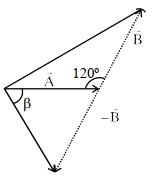
The angle between vector $(\overrightarrow{{A}})$ and $(\overrightarrow{{A}}-\overrightarrow{{B}})$ is :