Answer

  1. $\frac{1}{\text{n}_1-\text{n}_2}$

Explanation:

Time interval between two successive maxima = time interval between two successive beats

$=\frac{1}{\text{n}}=\frac{1}{\text{n}_1-\text{n}_2}$

Need a full question paper?

Generate a complete, print-ready paper with questions like this in minutes — across 16+ boards, with answer keys.
Start Generating Free

Similar questions

Two balls are thrown simultaneously from ground with same velocity of $10\,m / s$ but different angles of projection with horizontal. Both balls fall at same distance $5 \sqrt{3}\,m$ from point of projection. What is the time interval between balls striking the ground?
A hydraulic automobile lift is designed to lift cars with a maximum mass of $3000\; kg$. The area of cross-section of the piston carrying the load is $425 \;cm ^{2} .$ What maximum pressure would the smaller piston have to bear?
A glass full of hot milk is poured on the table. It begins to cool gradually. Which of the following is correct?
  1. The rate of cooling is constant till milk attains the temperature of the surrounding.
  2. The temperature of milk falls off exponentially with time.
  3. While cooling, there is a flow of heat from milk to the surrounding as well as from surrounding to the milk but the net flow of heat is from milk to the surounding and that is why it cools.
  4. All three phenomenon, conduction, convection and radiation are responsible for the loss of heat from milk to the surroundings.
Two vibrating tuning forks produce progressive waves given by ${Y_1} = 4\sin 500\pi t$ and ${Y_2} = 2\sin 506\pi t.$ Number of beats produced per minute is
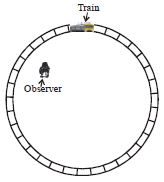
An engine is moving with uniform speed along a circular track emitting a sound of frequency $400\, Hz$ as shown in the figure. Speed of engine is $30\, m/sec$ and speed of sound is $330\, m/sec$. An observer is standing inside the track. Maximum frequency observed by the observer is
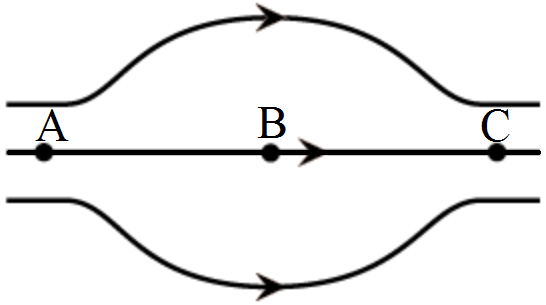
Figure, shows some of the electric field lines corresponding to an electric field. The figure suggests that,

  1. EA > E8 > Ee
  2. EA = EB = Ee
  3. EA = Ec > EB
  4. EA = Ec < EB.
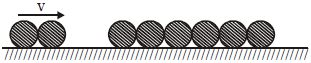
Six identical balls are lined in a straight groove made on a horizontal frictionless surface.  Two similar balls each moving with a velocity $v$ collide elastically with the row of $6\, balls$ from left. What will happen ?
Assertion $(A)$: In an elastic collision between two bides, the relative speed of the bodies after collision is equal to the relative speed before the collision.

Reason $(R)$: In elastic collision, the linear momentum of the system is conserved.

The pressure of a gas kept in an isothermal container is 200kPa. If half the gas is removed from it, the pressure will be:
  1. 100kPa.
  2. 200kPa.
  3. 400kPa.
  4. 800kPa.
A string in musical instrument is $50 cm$ long and its fundamental frequency is $800 Hz.$ If a frequency of $1000 Hz$ is to be produced, then required length of string is ..... $cm$