MCQ
Two H atoms in the ground state collide inelastically. The maximum amount by which their combined kinetic energy is reduced is:
- A10.20eV.
- B20.40eV.
- C13.6eV.
- D27.2eV.
Solution:
Key concept: Total energy (E) is the sum of potential energy and kinetic energy, i.e. E = K + U
$\Rightarrow\ \text{E}=-\frac{\text{kZe}^2}{2\text{r}_\text{n}}\text{also r}_\text{n}=\frac{\text{n}^2\text{h}^2\in_0}{\pi\text{mze}^2}$
Hence $\text{E}=-\bigg(\frac{\text{me}^4}{8\in_0^2\text{h}^2}\bigg)\frac{\text{Z}^2}{\text{n}^2}=-\bigg(\frac{\text{me}^4}{8\in_0^2\text{ch}^3}\bigg)\text{ch}\frac{\text{Z}^2}{\text{n}^2}$
$=-\text{R ch}\frac{\text{Z}^2}{\text{n}^2}=-13.6\frac{\text{Z}^2}{\text{n}^2}\text{eV}$
The lowest state of the atom, called the ground state, is that of the lowest energy. The energy of this state (n = 1), E1 is -13.6eV
Energy level diagram of hydrogen/hydrogen like atom:
| Principal quantum number | Orbit | Excited state | Energy of H2 - atom |
| $\text{n}=\infty$ | Infinite | Infinite | 0eV |
| n = 4 | Fourth | Third | -0.85eV |
| n = 3 | Third | Second | -1.51eV |
| n = 2 | Second | First | -3.4eV |
| n = 1 | First | Ground | -13.6eV |
Let two H atoms initially at in the ground state.Now two stoms collide inclastically. The total energy associated with the tow H-atoms
= 2 × (13.6 eV) = 27.2eV
The maximum amount by which their combined kinetic energy is reduced when any one of them goes into first excited state (n = 2) after the inclastic collision.
The total energy associated with the two H-atoms after the collision
$=\Big(\frac{13.6}{2^2}\Big)+(13.6)=17.0\text{eV}$
Hence, maximum loss of their combined kinetic energy
= 27.2 - 17.0 = 10.2eV.
Generate a complete, print-ready paper with questions like this in minutes — across 16+ boards, with answer keys.
The positive temperature coefficient of resistance is for
|
(a) Carbon |
(b) Germanium |
(c) Copper |
(d) An electrolyte |
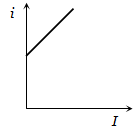
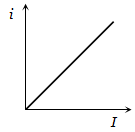
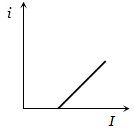
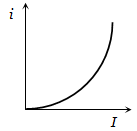
The graph between intensity of light falling on a metallic plate (I) with the current (i) generated is
|
(a)
|
(b)
|
(c)
|
(d)
|
An object is placed first at infinity and then at 20 cm from the object side focal plane of the convex lens. The two images thus formed are 5 cm apart. The focal length of the lens is
|
(a) 5 cm |
(b) 10 cm |
(c) 15 cm |
(d) 20 cm |
Which of the planet is brightest
|
(a) Mercury |
(b) Venus |
(c) Mars |
(d) Jupiter |
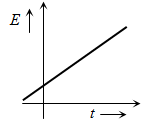
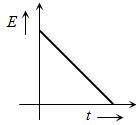
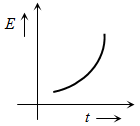
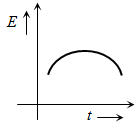
Two different metals are joined end to end. One end is kept at constant temperature and the other end is heated to a very high temperature. The graph depicting the thermo e.m.f. is
|
(a)
|
(b)
|
(c)
|
(d)
|