Question
Two heater coils made of same material are connected in parallel across the mains. The length and diameter of the wire of one of coils are double that of the other. Which one of them will produce more heat?

Answer

We have resistance of one wire,
$\text{R}_1=\frac{\rho\text{l}}{\text{A}}=\frac{\rho\text{l}}{\pi\text{r}^2}=\frac{4\rho\text{l}}{\pi\text{D}^2}$
Where l is length and D is diameter of the wire. The resistance of second wire of double the length and double the diameter is,
$\text{R}_2=\frac{4\rho(2\text{l})}{\pi(2\text{D})^2}=\frac{4\rho\text{l}}{\pi\text{D}^2}.\frac12,\text{ i.e.,}\text{ R}_2=\frac{\text{R}_1}{2}$
Heat produced per second,
$\text{H}=\frac{\text{V}^2}{\text{R}}\propto\frac{1}{\text{R}}$
As second coil has resistance equal to half of first coil, therefore heat produced in second coil is double than that in first coil.

Need a full question paper?

Generate a complete, print-ready paper with questions like this in minutes — across 16+ boards, with answer keys.
Start Generating Free

Similar questions

The drift current in a reverse-biased p-n junction increases in magnitude if the temperatu,re of the junction is increased. Explain this on the basis of creation of hole-electron pairs.
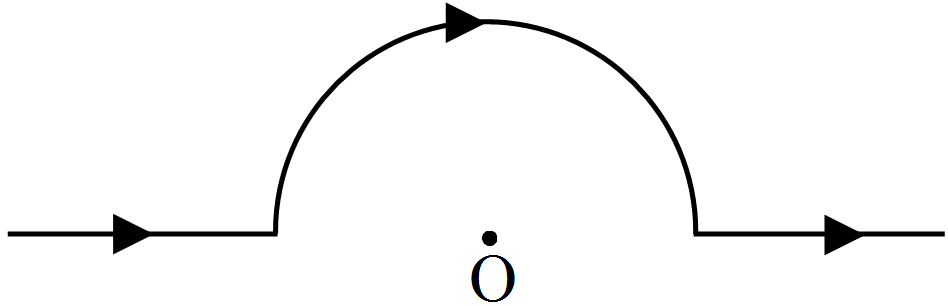
A straight wire carrying a current of 12A is bent into a semi-circular arc of radius 2.0cm as shown. What is the magnetic field at O due to:
  1. Straight segments.
  2. The semi-circular arc?
Consider a 10cm long piece of a wire which carries a current of 10A. Find the magnitude of the magnetic field due to the piece at a point which makes an equilateral triangle with the ends of the piece.
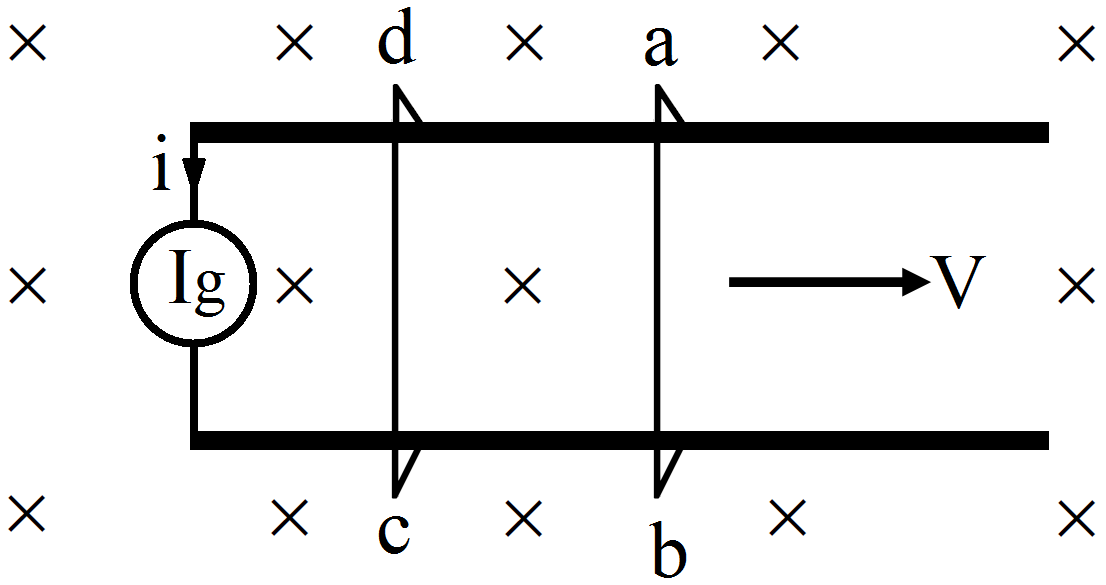
The current generator $I_g$ shown in figure, sends a constant current i through the circuit. The wire cd is fixed and ab is made to slide on the smooth, thick rails with a constant velocity v towards right. Each of these wires has resistance r. Find the current through the wire cd.
Draw the circuit diagram showing how a p-n junction diode is
i. forward biased
ii. reverse biased
How is the width of depletion layer affected in the two cases?
A 10cm long rod carries a charge of $+50\mu\text{C}$ distributed uniformly along its length. Find the magnitude of the electric field at a point 10cm from both the ends of the rod.
  1. In Young's double slit experiment, two slits are 1 mm apart, and the screen is placed 1 m away from the slits. Calculate the fringe width when light of wavelength 500 nm is used.
  2. What should be the width of each slit in order to obtain 10 maxima of the double slits pattern within the central maximum of the single slit pattern?
Can we perform Young's double slit experiment with sound waves? To get a reasonable "fringe pattern", what should be the order of separation between the slits? How can the bright fringes and the dark fringes be detected in this case?
  1. The refractive index of glass is 1.5. What is the speed of light in glass? $($Speed of light in vacuum is $3.0 \times 10^8 ms^{–1}).$
  2. Is the speed of light in glass independent of the colour of light? If not, which of the two colours red and violet travels slower in a glass prism?
  1. What is total internal reflection? Under what conditions does it occur?
  2. Find a relation between critical angle and refractive index.
  3. Name one phenomenon which is based on total internal reflection.