Two heater wires of equal length are first connected in series and then in parallel. The ratio of heat produced in the two cases is
AIIMS 2000, Medium
Download our app for free and get started
(d) Power consumed means heat produced.
For constant potential difference ${P_{{\rm{consumed}}}} = {\rm{Heat}} \propto \frac{1}{{{R_{eq}}}}$
$\therefore \frac{{{H_1}}}{{{H_2}}} = \frac{{{R_2}}}{{{R_1}}} = \frac{{R/2}}{{2R}} = \frac{1}{4}$
(Since ${R_2} = \frac{{R.R}}{{R + R}} = \frac{R}{2}$and ${R_1} = R + R = 2R)$
For constant potential difference ${P_{{\rm{consumed}}}} = {\rm{Heat}} \propto \frac{1}{{{R_{eq}}}}$
$\therefore \frac{{{H_1}}}{{{H_2}}} = \frac{{{R_2}}}{{{R_1}}} = \frac{{R/2}}{{2R}} = \frac{1}{4}$
(Since ${R_2} = \frac{{R.R}}{{R + R}} = \frac{R}{2}$and ${R_1} = R + R = 2R)$

Download our appand get started for free
Experience the future of education. Simply download our apps or reach out to us for more information. Let's shape the future of learning together!No signup needed.*
Similar Questions
- 1Two electric lamps of $40\, watt$ each are connected in parallel. The power consumed by the combination will be ........... $watt$View Solution
- 2A ($100\, W$, $200\, V$) bulb is connected to a $160\, V$ power supply. The power consumption would be ............. $W$View Solution
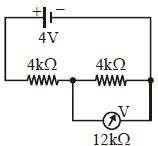
- 3The percentage error in the reading of the voltmeter in the figure shown here is nearly ............ $\%$View Solution
- 4View SolutionThe resistance of a discharge tube is
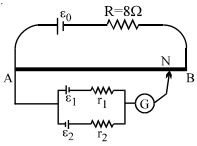
- 5$A$ battery of $\mathrm{emf}$ $E_0 = 12\, V$ is connected across a $4\,m$ long uniform wire having resistance $4\,\Omega /m$. The cells of small $\mathrm{emfs}$ $\varepsilon_1 = 2\,V$ and $\varepsilon_2 = 4\,V$ having internal resistance $2\Omega$ and $6\Omega$ respectively, are connected as shown in the figure. If galvanometer shows no deflection at the point $N$, the distance of point $N$ from the point $A$ is equal toView Solution
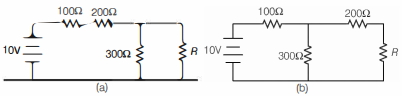
- 6A student was trying to construct the circuit shown in the figure below marked $(a)$, but ended up constructing the circuit marked $(b)$. Realising her mistake, she corrected the circuit, but to her surprise, the output voltage (across $R$ ) did not change. The value of resistance $R$ is ............ $\Omega$View Solution
- 7Resistance of the wire is measured as $2\,\Omega$ and $3\,\Omega$ at $10^{\circ}C$ and $30^{\circ}C$ respectively. Temperature cocoefficient of resistance of the material of the wire is............$^{\circ}C ^{-1}$View Solution
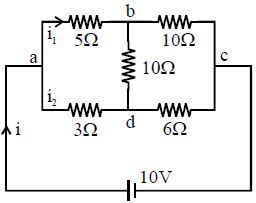
- 8Find current through the branch $ad$ of the circuit shown in figure. :-............. $A$View Solution
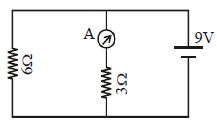
- 9In the figure shown, if the internal resistance of the battery is $1\, ohm$ , the reading of the ammeter will be ................. $\mathrm{A}$View Solution
- 10View SolutionWhen cells are connected in parallel, then