Resistance of the wire is measured as $2\,\Omega$ and $3\,\Omega$ at $10^{\circ}C$ and $30^{\circ}C$ respectively. Temperature cocoefficient of resistance of the material of the wire is............$^{\circ}C ^{-1}$
JEE MAIN 2022, Medium
Download our app for free and get started
$R = R _{0}(1+\alpha \Delta T )$
$3= R _{0}(1+\alpha(30-0))$
$2= R _{0}(1+\alpha(10-0))$
$\frac{3}{2}=\frac{1+30 \alpha}{1+10 \alpha}$
$\alpha=\frac{1}{30}=0.033$

Download our appand get started for free
Experience the future of education. Simply download our apps or reach out to us for more information. Let's shape the future of learning together!No signup needed.*
Similar Questions
- 1View SolutionWhen there is an electric current through a conducting wire along its length, then an electric field must exist
- 2If a $30\, V$, $90\, W$ bulb is to be worked on a $120\, V$ line, a resistance of how many ohms should be connected in series with the bulb ............... $ohm$View Solution
- 3View SolutionWhen current flows through a conductor, then the order of drift velocity of electrons will be
- 4At what temperature will the resistance of a copper wire become three times its value at $0\,^oC$ ................. $^oC$ (Temperature coefficient of resistance for copper = $4 × 10^{-3} \,per\, \,^oC$ )View Solution
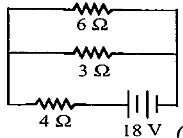
- 5The total power dissipated in watt in the circuit shown here is ............. $W$View Solution
- 6A wire of resistance $R$ is divided in $10$ equal parts. These parts are connected in parallel, the equivalent resistance of such connection will beView Solution
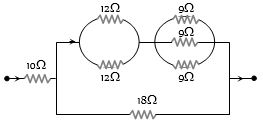
- 7In the following circuit, $18\,\Omega $ resistor develops $2\,J/sec$ due to current flowing through it. The power developed across $10\,\Omega $ resistance is .............. $W$View Solution
- 8Two cells, $e.m.f.$ of each is $E$ and internal resistance $r$ are connected in parallel between the resistance $R$. The maximum energy given to the resistor will be, only whenView Solution
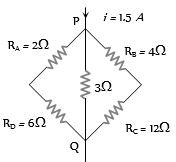
- 9Potential difference between the points $P$ and $Q$ in the electric circuit shown is ................. $V$View Solution
- 10The maximum power drawn out of the cell from a source is given by (where $r$ is internal resistance)View Solution