Question
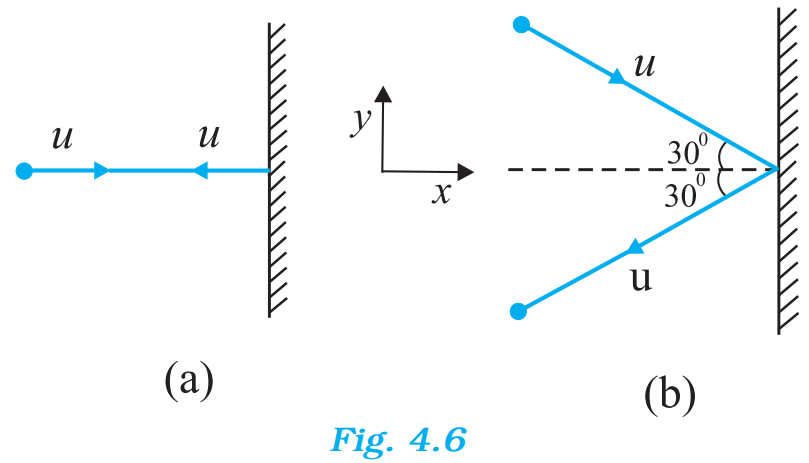
Two identical billiard balls strike a rigid wall with the same speed but at different angles, and get reflected without any change in speed, as shown in Fig. 4.6. What is (i) the direction of the force on the wall due to each ball? (ii) the ratio of the magnitudes of impulses imparted to the balls by the wall ?
Image

Answer

An instinctive answer to (i) might be that the force on the wall in case (a) is normal to the wall, while that in case (b) is inclined at 30 to the normal. This answer is wrong. The force on the wall is normal to the wall in both cases.
How to find the force on the wall? The trick is to consider the force (or impulse) on the ball due to the wall using the second law, and then use the third law to answer (i). Let $u$ be the speed of each ball before and after collision with the wall, and $m$ the mass of each ball. Choose the $x$ and $y$ axes as shown in the figure, and consider the change in momentum of the ball in each case :
Case (a)
$
\begin{array}{ll}
\left(p_x\right)_{\text {initial }}=m u & \left(p_y\right)_{\text {iritital }}=0 \\
\left(p_x\right)_{\text {final }}=-m u & \left(p_y\right)_{\text {trial }}=0
\end{array}
$
Impulse is the change in momentum vector. Therefore,
$x$-component of impulse $=-2 mu$
$y$-component of impulse $=0$
Impulse and force are in the same direction. Clearly, from above, the force on the ball due to the wall is normal to the wall, along the negative $x$-direction. Using Newton's third law of motion,
the force on the wall due to the ball is normal to the wall along the positive $x$-direction. The magnitude of force cannot be ascertained since the small time taken for the collision has not been specified in the problem.
Case (b)
$
\left(p_x\right)_{\text {initial }}=m \ u \cos 30^{\circ},\left(p_y\right)_{\text {initial }}=-m \ u \sin 30^{\circ}
$
$
\left(p_x\right)_{\text {final }}=-m \ u \cos 30^{\circ},\left(p_y\right)_{\text {final }}=-m \ u \sin 30^{\circ}
$
Note, while $p_x$ changes sign after collision, $p_y$ does not. Therefore,
$
x \text {-component of impulse }=-2 m \ u \cos 30
$
$
y \text {-component of impulse }=0
$ The direction of impulse (and force) is the same as in (a) and is normal to the wall along the negative $x$ direction. As before, using Newton's third law, the force on the wall due to the ball is normal to the wall along the positive $x$ direction.
The ratio of the magnitudes of the impulses imparted to the balls in (a) and (b) is
$
2 m u /\left(2 m \ u \cos 30^{\circ}\right)=\frac{2}{\sqrt{3}} \approx 1.2
$

Need a full question paper?

Generate a complete, print-ready paper with questions like this in minutes — across 16+ boards, with answer keys.

Start Generating Free

Similar questions

A heavy particle is suspended by a 1.5m long string. It is given a horizontal velocity of $\sqrt{57}\text{m/s}.$
  1. Find the angle made by the string with the upward vertical, when it becomes slack.
  2. Find the speed of the particle at this instant.
  3. Find the maximum height reached by the particle over the point of suspension. Take g = 10m/s2.
What is the excess pressure inside a bubble of soap solution of radius 5.00mm, given that the surface tension of soap solution at the temperature (20°C) is 2.50 × 10⁻² Nm–1? If an air bubble of the same dimension were formed at depth of 40.0cm inside a container containing the soap solution (of relative density 1.20), what would be the pressure inside the bubble? (1 atmospheric pressure is 1.01 × 10⁵Pa).
A three-wheeler starts from rest, accelerates uniformly with 1m s–2 on a straight road for 10s, and then moves with uniform velocity. Plot the distance covered by the vehicle during the nth second (n = 1, 2, 3….) versus n. What do you expect this plot to be during accelerated motion : a straight line or a parabola?
  1. Define critical velocity of liquid flow and state the factors affecting the critical velocity of liquid.
  2. Define terminal velocity. Establish an expression for it for a spherical body falling through a viscous medium.
A point source emitting alpha particles is placed at a distance of 1m from a counter which records any alpha particle falling on its 1cm2 window. If the source contains 6.0 × 10¹⁶ active nuclei and the counter records a rate of 50000 counts/ second, find the decay constant. Assume that the source emits alpha particles uniformly in all directions and the alpha particles fall nearly normally on the window.
Consider the following very rough model of a beryllium atom. The nucleus has four protons and four neutrons confined to a small volume of radius 10-15m. The two 1s electrons make a spherical charge cloud at an average distance of 1.3 × 10⁻¹¹m from the nucleus, whereas the two 2s electrons make another spherical cloud at an average distance of 5.2 × 10⁻¹¹m from the nucleus. Find the electric field at:
  1. A point just inside the 1s cloud.
  2. A point just inside the 2s cloud.
An oxygen cylinder of volume 30 litres has an initial gauge pressure of 15 atm and a temperature of 27°C. After some oxygen is withdrawn from the cylinder, the gauge pressure drops to 11 atm and its temperature drops to 17°C. Estimate the mass of oxygen taken out of the cylinder (R = 8.31J mol-1K-1, molecular mass of O2 = 32u).
A 70kg man stands in contact against the inner wall of a hollow cylindrical drum of radius 3m rotating about its vertical axis with 200rev/min. The coefficient of friction between the wall and his clothing is 0.15. What is the minimum rotational speed of the cylinder to enable the man to remain stuck to the wall (without falling) when the floor is suddenly removed?
A particle of mass m is kept on the top of a smooth sphere of radius R. It is given a sharp impulse which imparts it a horizontal speed v.
  1. Find the normal force between the sphere and the particle just after the impulse.
  2. What should be the minimum value of v for which the particle does not slip on the sphere?
  3. Assuming the velocity v to be half the minimum calculated in part.
  4. Find the angle made by the radius through the particle with the vertical when it leaves the sphere.

State, for each of the following physical quantities, if it is a scalar or a vector : volume, mass, speed, acceleration, density, number of moles, velocity, angular frequency, displacement, angular velocity.