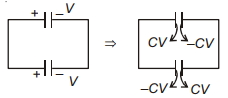
Two identical capacitors are connected in parallel across a potenial difference $V$. After they are fully charged, the positive plate of first capacitor is connected to negative plate of second and negative plate of first is connected to positive plate of other. The loss of energy will be
A$\frac{1}{2} C V^2$
B$CV ^2$
C$\frac{1}{4} C V^2$
D$0$
Easy
Download our app for free and get started
B$CV ^2$
b (b)
$U_i=\frac{1}{2} C V^2+\frac{1}{2} C V^2=C V^2$
$U_f=0$
$\Delta U=C V^2$
Download our app
and get started for free
Experience the future of education. Simply download our apps or reach out to us for more information. Let's shape the future of learning together!No signup needed.*
A force $F$ acts between sodium and chlorine ions of salt (sodium chloride) when put $1\,cm$ apart in air. The permittivity of air and dielectric constant of water are ${\varepsilon _0}$ and $K$ respectively. When a piece of salt is put in water electrical force acting between sodium and chlorine ions $1\,cm$ apart is
In the adjoining figure, four capacitors are shown with their respective capacities and the $P.D.$ applied. The charge and the $P.D.$ across the $4\,\mu F$ capacitor will be
Four identical charges $ + \,50\,\mu C$ each are placed, one at each corner of a square of side $2\,m$. How much external energy is required to bring another charge of $ + \,50\,\mu C$ from infinity to the centre of the square......$J$ $\left( {{\rm{Given}}\frac{{\rm{1}}}{{{\rm{4}}\pi {\varepsilon _{\rm{0}}}}} = 9 \times {{10}^9}\,\frac{{N{m^2}}}{{{C^2}}}} \right)$
Charge is uniformly distributed on the surface of a hollow hemisphere. Let $O$ and $A$ be two points on the base of the hemisphere and $V_0$ and $V_A$ be the electric potentials at $O$ and $A$ respectively. Then,
Two spherical conductors $A$ and $B$ of radius $a$ and $b (b > a)$ are placed in air concentrically $B$ is given charge $+ Q$ coulomb and $A$ is grounded. The equivalent capacitance of these is
A charge $+q$ is fixed at each of the points $x = x_0,\,x = 3x_0,\,x = 5x_0$, .... upto $\infty $ on $X-$ axis and charge $-q$ is fixed on each of the points $x = 2x_0,\,x = 4x_0,\,x = 6x_0$, .... upto $\infty $ . Here $x_0$ is a positive constant. Take the potential at a point due to a charge $Q$ at a distance $r$ from it to be $\frac{Q}{{4\pi {\varepsilon _0}r}}$. Then the potential at the origin due to above system of charges will be
The distance between the plates of a parallel plate condenser is $8\,mm$ and $P.D.$ $120\;volts$. If a $6\,mm$ thick slab of dielectric constant $6$ is introduced between its plates, then
The charge across the capacitor in two different $RC$ circuits $1$ and $2$ are plotted as shown in figure. Choose the correct statement $(s)$ related to the two circuits.