A force $F$ acts between sodium and chlorine ions of salt (sodium chloride) when put $1\,cm$ apart in air. The permittivity of air and dielectric constant of water are ${\varepsilon _0}$ and $K$ respectively. When a piece of salt is put in water electrical force acting between sodium and chlorine ions $1\,cm$ apart is
Easy


Download our appand get started for free
Experience the future of education. Simply download our apps or reach out to us for more information. Let's shape the future of learning together!No signup needed.*
Similar Questions
- 1A neutral spherical copper particle has a radius of $10 \,nm \left(1 \,nm =10^{-9} \,m \right)$. It gets charged by applying the voltage slowly adding one electron at a time. Then, the graph of the total charge on the particle versus the applied voltage would look likeView Solution
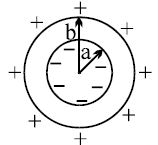
- 2$IAn$ empty thick conducting shell of inner radius $a$ and outer radius $b$ is shown in figure.If it is observed that the inner face of the shell carries a uniform charge density $-\sigma$ and the surface carries a uniform charge density $ '\sigma '$View Solution
Choose the correct statement related to the potential of the shell in absence of $q_B$
- 3A charge of total amount $Q$ is distributed over two concentric hollow spheres of radii $r$ and $R ( R > r)$ such that the surface charge densities on the two spheres are equal. The electric potential at the common centre isView Solution
- 4Two capacitors of capacities $2 {C}$ and ${C}$ are joined in parallel and charged up to potential ${V}$. The battery is removed and the capacitor of capacity $C$ is filled completely with a medium of dielectric constant ${K}$. The potential difference across the capacitors will now beView Solution
- 5Assertion : A parallel plate capacitor is connected across battery through a key. A dielectric slab of dielectric constant $K$ is introduced between the plates. The energy which is stored becomes $K$ times.View Solution
Reason : The surface density of charge onthe plate remains constant or unchanged.
- 6The ratio of momenta of an electron and an $\alpha$-particle which are accelerated from rest by a potential difference of $100\, volts$ isView Solution
- 7A combination of parallel plate capacitors is maintained at a certain potential difference When a $3\, mm$ thick slab is introduced between all the plates, in order to maintain the same potential difference, the distance between the plates is increased by $2.4\, mm$. Find the dielectric constant of the slab.View Solution
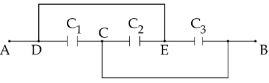
- 8To obtain $3\,\mu F$ capacity from three capacitors of $2\,\mu F$ each, they will be arrangedView Solution
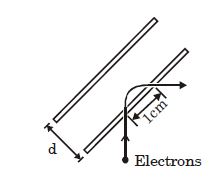
- 9A problem of practical interest is to make a beam of electrons turn at $90^o$ corner. This can be done with the electric field present between the parallel plates as shown in the figure. An electron with kinetic energy $8.0 × 10^{-17}\ J$ enters through a small hole in the bottom plate. The strength of electric field that is needed if the electron is to emerge from an exit hole $1.0\ cm$ away from the entrance hole, traveling at right angles to its original direction is $y × 10^5\ N/C$ . The value of $y$ isView Solution
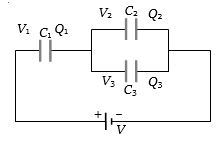
- 10In an adjoining figure are shown three capacitors ${C_1}$,${C_2}$ and ${C_3}$ joined to a battery. The correct condition will be (Symbols have their usual meanings)View Solution